Theme parks and video games share a fundamental goal: they must transform passive visitors into engaged participants who return again and again. Over the past decade, park operators have quietly adopted the mechanics that make games compulsively replayable. From achievement systems to progression loops, the psychology powering your favorite mobile app now shapes how you experience a physical attraction. This convergence is not accidental. It reflects a deliberate strategy to extend guest engagement well beyond a single visit.
The Rise of Gamified Attractions
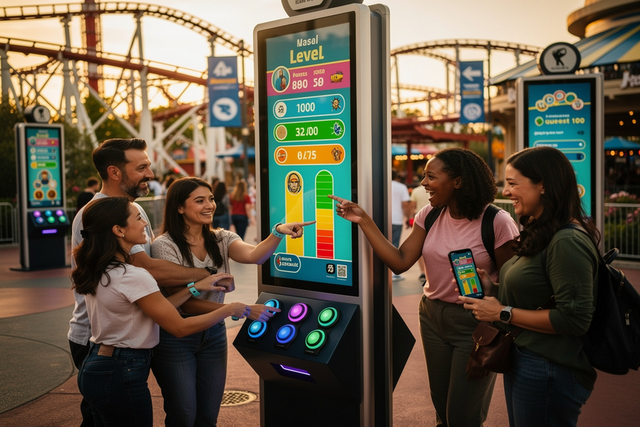
Traditional rides offered a linear experience: you queued, you rode, you exited. Modern parks reject this model. Interactive dark rides now hand guests blasters, scanners, and scoring systems that turn spectators into competitors. Attractions like Toy Story Midway Mania and Men in Black Alien Attack reward accuracy, encourage repeat rides, and generate the same dopamine-driven feedback loops found in arcade cabinets. The scoreboard is the hook. When guests can measure improvement, they treat a ride as a challenge to master rather than a moment to consume once.
Designers understand that measurable progress creates motivation. A visible score converts a one-time thrill into a personal benchmark, and benchmarks demand another attempt.
Apps, Achievements, and Progression Systems
Mobile applications have become the connective tissue between physical parks and digital game design. Park apps now include collectible badges, hidden objectives, and location-based challenges that mirror mobile gaming conventions. Industry analysts examining how developers apply game design principles note that these tools extend engagement before, during, and after a visit. Guests plan itineraries like they would plan a raid, unlocking rewards by completing tasks scattered across the property.
This achievement architecture borrows directly from role-playing games. Completion percentages, streaks, and tiered rewards exploit the human desire for closure. A half-finished collection nags at visitors until they book a return trip to finish it.
Reward Loops and the Psychology of Return
The core mechanic driving both industries is the reward loop: action, feedback, reward, repeat. Parks engineer these loops through loyalty programs, annual passes, and tiered membership perks. Each visit unlocks new benefits, and the anticipation of the next reward keeps guests committed. This mirrors how well-designed bets and gaming platforms use variable reinforcement to sustain attention over long periods.
Variable rewards are particularly powerful. When guests never know exactly which surprise awaits them, whether a character encounter, a limited edition item, or a seasonal event, the uncertainty itself becomes compelling. Predictable rewards satisfy briefly; unpredictable ones create sustained engagement. Parks deploy rotating seasonal overlays and surprise activations precisely because novelty resets the reward cycle and justifies another purchase.
When Studios and Parks Collaborate
The relationship between games and parks now runs in both directions. Entertainment conglomerates increasingly treat their intellectual property as a single ecosystem spanning screens and physical space. Coverage of how major studios pursue video game strategies illustrates that characters and worlds are designed to migrate seamlessly across platforms. A guest who meets a character in a game may later seek that same character at a park, and vice versa.
This cross-pollination strengthens brand loyalty. Familiarity built in one medium transfers to another, lowering the barrier to engagement and increasing the perceived value of every touchpoint. The park becomes a level within a larger franchise experience.
Data as the Invisible Game Master
Behind every gamified attraction sits a data engine. Parks collect behavioral information through apps, wearable devices, and purchase histories. This data functions like a game master adjusting difficulty and pacing in real time. Operators analyze which challenges guests complete, where they linger, and what rewards trigger spending. They then refine offerings to maximize engagement.
This analytical approach challenges the conventional wisdom that park design is purely creative. In reality, it is increasingly empirical, guided by metrics that would be familiar to any live-service game producer tracking player retention.
The Strategic Takeaway
The lesson for operators is clear: engagement is engineered, not assumed. By adopting scoring systems, achievement structures, variable rewards, and data-driven refinement, parks convert visitors into loyal participants. The most successful attractions no longer end at the exit gate. They continue in an app, a collection, or an anticipated return trip.
As physical and digital entertainment continue to merge, the boundary between playing a game and visiting a park will keep dissolving. Parks that master these borrowed mechanics will command guest loyalty, while those that ignore them risk becoming a single-play experience in a world built for replay.

Wayne is a unique blend of gamer and coder, a character as colorful and complex as the worlds he explores and the programs he crafts. With a sharp wit and a knack for unraveling the most tangled lines of code, he navigates the realms of pixels and Python with equal enthusiasm. His stories aren’t just about victories and bugs; they’re about the journey, the unexpected laughs, and the shared triumphs. Wayne’s approach to gaming and programming isn’t just a hobby, it’s a way of life that encourages curiosity, persistence, and, above all, finding joy in every keystroke and every quest.