
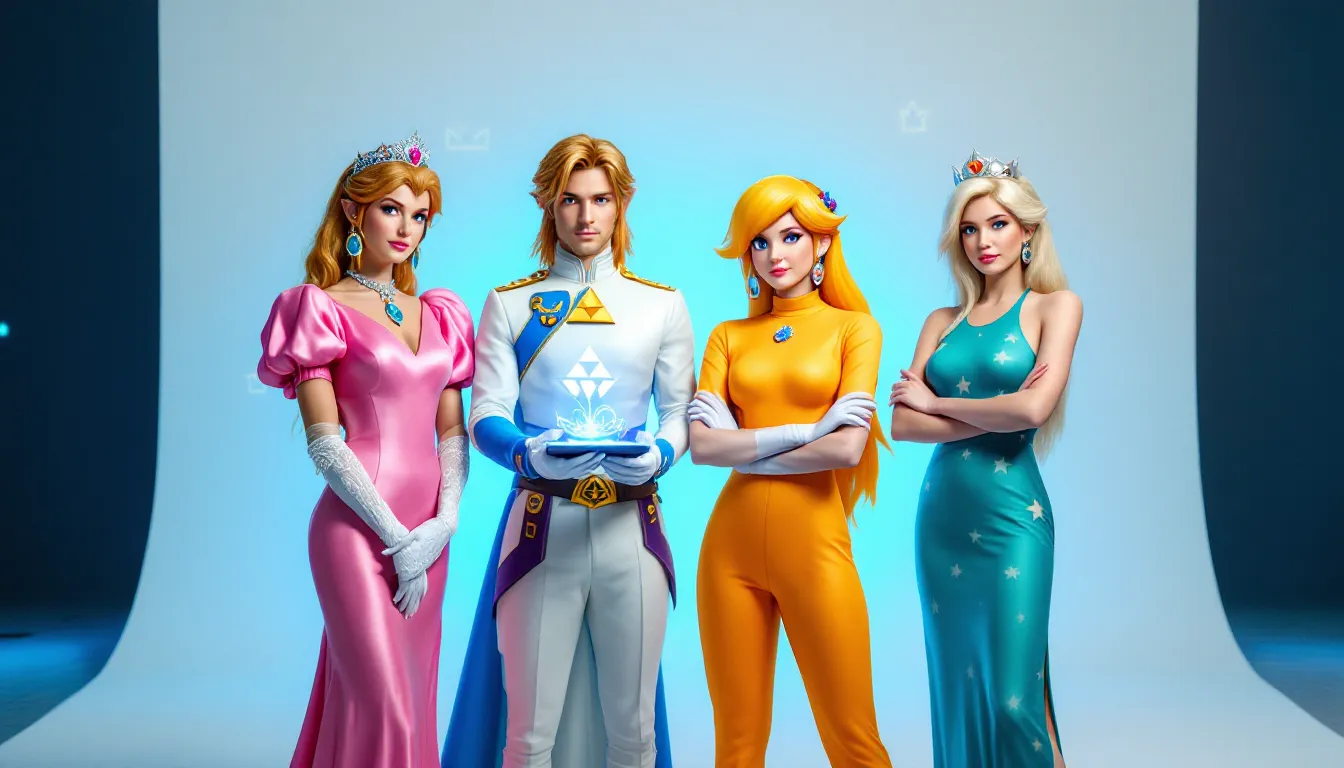
Nintendo’s princesses have become some of the most recognizable characters in gaming history. From Peach’s pink dress to Zelda’s magical prowess, these royal figures have evolved far beyond their damsel-in-distress origins. They’ve headlined their own games, wielded legendary powers, and become cultural icons that transcend the medium itself.
This guide covers every major Nintendo princess, their powers, their stories, and their impact on gaming. Whether you’re here for competitive Smash Bros frame data or just curious about Rosalina’s cosmic backstory, we’ve got the details.
Key Takeaways
- Nintendo princesses have evolved from damsels in distress to playable protagonists and solo game stars, with Peach, Zelda, Daisy, and Rosalina each defining distinct gameplay mechanics and narrative roles.
- Princess Peach transformed from her 1985 platformer origins into a mechanical powerhouse across 60+ games, with unique abilities like float jumps in platformers and frame-perfect tech like float-cancel in competitive Smash Bros.
- Princess Zelda transcends a single character—spanning thousands of years across multiple timelines—with incarnations ranging from strategic planners in Ocarina of Time to dragon-form sacrifices in Tears of the Kingdom.
- Rosalina’s cosmic-guardian role and tragic backstory gave the Mario franchise unprecedented emotional depth, establishing her as more than a princess but a goddess-like figure who commands the Comet Observatory.
- Modern Nintendo princess games like Princess Peach: Showtime (2024) and Echoes of Wisdom (2024) feature princesses as sole protagonists, finally delivering the dedicated adventures fans requested for decades.
- Nintendo princesses have shaped gaming culture across competitive play, merchandise, cosplay, and broader industry conversations about female representation, proving ‘princess’ characters can dominate competitive gaming and drive cultural influence.
Who Are the Nintendo Princesses?
Nintendo’s roster of princesses spans multiple franchises and decades of gaming. The term typically refers to royal or noble female characters who’ve appeared in Nintendo-published games, though the definition gets flexible when you factor in third-party titles like Fire Emblem.
The core lineup includes Princess Peach from the Mario franchise, Princess Zelda from The Legend of Zelda, Princess Daisy from Super Mario Land, and Princess Rosalina from the Super Mario Galaxy series. Each brings distinct abilities, personality traits, and narrative roles to their respective games.
Beyond the main four, Nintendo’s catalog includes lesser-known royalty like Princess Shokora from Wario Land 4, Princess Ruto from Ocarina of Time, and dozens of Fire Emblem princesses across that tactical RPG series. Some appear as playable heroes, others as quest-givers or plot-critical NPCs.
What separates Nintendo princesses from generic fantasy royalty is their active participation in their worlds. Modern iterations fight, cast spells, rule kingdoms, and occasionally save the heroes who once saved them.
Princess Peach: The Mushroom Kingdom’s Beloved Monarch
Princess Peach (originally Princess Toadstool in Western releases until 1996) debuted in Super Mario Bros. in 1985. As the ruler of the Mushroom Kingdom, she’s been kidnapped by Bowser more times than any character in gaming, seriously, it’s a running joke at this point.
But Peach is far more than a plot device. She’s appeared as a playable character in over 60 games, including the mainline Super Mario Bros. 2 (USA) where she could float using her dress, a mechanic that made her the top-tier speedrun choice for certain levels.
Peach’s Evolution from Damsel to Hero
Peach’s shift from kidnapping victim to active protagonist hit its stride with Super Princess Peach (Nintendo DS, 2005). The game flipped the script entirely: Mario and Luigi got captured, and Peach wielded the Vibe Scepter to rescue them. Her emotion-based powers, joy, rage, calm, and gloom, controlled environmental puzzles and combat.
Super Mario 3D World (2013) and its Switch port Bowser’s Fury (2021) made Peach a fully playable character in mainline 3D Mario. Her floating ability returned, offering more forgiving platforming compared to Mario’s balanced stats or Luigi’s high jumps. In Super Mario Bros. Wonder (2023), Peach finally got equal billing as a launch character with unique animations and voice lines.
The upcoming Princess Peach: Showtime. (March 2024, Nintendo Switch) puts her front and center in a theatrical adventure where she transforms into different roles, swordfighter, detective, pastry chef, each with distinct gameplay mechanics. It’s the first solo Peach game in nearly 20 years.
Peach’s Powers and Abilities Across Games
Peach’s moveset varies wildly depending on the game genre:
Platformers:
- Float Jump: Hold jump to glide (SMB2, 3D World, Smash Bros)
- Perry the Parasol: Melee weapon with charge attacks (Super Princess Peach)
- Vibe Powers: Emotion-based abilities affecting enemies and terrain
Fighting Games (Super Smash Bros Ultimate):
- Neutral B – Toad Counter: 1.5x damage multiplier on successful counters
- Side B – Peach Bomber: 15% damage, kills at ~150% near ledge
- Down B – Turnip Pull: RNG-based projectile (1/300 chance for Beam Sword)
- Float Cancel: Advanced tech allowing instant aerial-to-ground transitions
Sports & Party Games:
- Balanced stats in Mario Kart (middleweight class)
- Technique-type in Mario Tennis with strong slice shots
- High Technique, low Power in Mario Golf: Super Rush
In Mario + Rabbids Kingdom Battle and Sparks of Hope, Peach wields a blaster and provides team healing, a support role that’s surprisingly effective in the turn-based tactics gameplay.
Princess Zelda: Wisdom, Magic, and Courage
Princess Zelda is the bearer of the Triforce of Wisdom and the mortal reincarnation of the goddess Hylia. Unlike Peach, Zelda isn’t a single character, she’s a bloodline spanning thousands of years across the complex Zelda timeline, with each incarnation possessing different personalities, abilities, and levels of combat prowess.
Zelda’s role varies dramatically by game. In Ocarina of Time (1998), she’s a strategic planner who guides Link through visions. In The Wind Waker (2002), she’s the pirate captain Tetra, unaware of her royal heritage until late-game. In Breath of the Wild (2017) and Tears of the Kingdom (2023), she’s a scholar-princess who unlocks her sealing powers through emotional trauma.
Zelda’s Many Incarnations Throughout the Timeline
The three timeline splits make tracking Zelda’s incarnations complex, but here are standouts:
Most Powerful:
- Twilight Princess Zelda: Transfers her soul to Midna to save her life, wields Light Arrows in the final battle
- Breath of the Wild/Tears of the Kingdom Zelda: Holds Calamity Ganon at bay for 100 years through sheer willpower, transforms into a dragon to preserve the Master Sword
Most Proactive:
- Spirit Tracks Zelda: Literally a ghost who possesses Phantom armor and fights alongside Link
- Hyrule Warriors Zelda: Leads armies, dual-wields rapiers, has a multi-hit combo string that rivals Link’s DPS
Most Mysterious:
- Skyward Sword Zelda: The original incarnation of Hylia in mortal form, directly responsible for sealing Demise and creating the Master Sword
- Echoes of Wisdom Zelda (September 2024, Nintendo Switch): Nintendo’s first mainline Zelda game with the princess as the sole protagonist, using magic echoes to solve puzzles
Zelda’s Role as Sheik and Other Alter Egos
Sheik remains Zelda’s most famous disguise. Introduced in Ocarina of Time, Sheik is a mysterious Sheikah warrior who teaches Link magical songs. The transformation involves Zelda using magic to alter her appearance, voice, and even physical capabilities, she’s faster, more acrobatic, and combat-trained as Sheik.
In Super Smash Bros, Sheik became a separate character from Melee onward (though they were transform-linked until Ultimate). Sheik’s frame data is some of the fastest in the game: her neutral air comes out frame 3, and her needles charge in 90 frames for maximum damage. She’s a high-skill rushdown character with some of the lowest kill power in the roster, a glass cannon built for combo damage.
Other Zelda alter egos include:
- Tetra (Wind Waker): Pirate captain identity maintained even after learning her heritage
- Phantom Armor (Spirit Tracks): Possessed armor that lets ghost-Zelda interact physically
- Dragon Form (Tears of the Kingdom): Zelda’s ultimate sacrifice, transforming into an immortal light dragon
Princess Daisy: The Spirited Ruler of Sarasaland
Princess Daisy debuted in Super Mario Land (Game Boy, 1989) as the damsel-in-distress for Mario’s portable adventure. Unlike Peach’s Mushroom Kingdom, Daisy rules Sarasaland, a collection of four kingdoms with Egyptian, Easter Island, Chinese, and ancient ruins themes. She was kidnapped by the alien villain Tatanga but was rescued by Mario in the game’s finale.
After that single starring role, Daisy vanished from mainline Mario games for years. Her resurrection came through the spin-off circuit: Mario Tennis (N64, 2000) marked her return, and she’s been a roster staple in sports, party, and kart games ever since.
Daisy’s personality sets her apart from Peach. She’s louder, more competitive, and tomboyish, her voice lines in Mario Kart and sports games are noticeably more aggressive. “Hi, I’m Daisy.” became a meme for how enthusiastically she delivers the line in Mario Kart: Double Dash and Super Mario Party.
Gameplay Stats:
- Mario Kart 8 Deluxe: Middleweight class (same as Peach but different vehicle synergies)
- Mario Tennis Aces: All-Around type with slightly better speed than Peach
- Super Smash Bros Ultimate: Echo fighter of Peach with different animations and hitboxes (turnips replaced with daisies, different knockback angles on some moves)
Daisy’s Flower Power aesthetic shows up across games, her special moves often involve flower petals or nature-themed effects. In Mario Strikers: Battle League (2022), her Hyper Strike covers the field in daisies that temporarily blind opponents.
She’s never gotten a solo adventure, which remains a sore point for fans. Daisy exists in a weird space: too established to ignore, but not pushed as hard as Peach or Rosalina in terms of narrative focus.
Princess Rosalina: Guardian of the Cosmos
Rosalina made her debut in Super Mario Galaxy (Wii, 2007) and immediately stood out from other Mario characters. She’s taller than Peach, has a melancholic demeanor, and wields a star wand. Instead of ruling a terrestrial kingdom, Rosalina commands the Comet Observatory, a mobile space station that travels the cosmos.
Rosalina isn’t just another princess. Her role is cosmic-level: she protects and nurtures Lumas (star-like creatures that transform into planets, galaxies, and power stars) while maintaining the cycle of universal rebirth. She’s essentially a goddess figure, though Nintendo keeps that vague.
Rosalina’s Backstory and Cosmic Significance
Rosalina’s storybook in Super Mario Galaxy reveals her tragic origin. As a child, she found a stranded Luma searching for its mother. They built a spaceship together to search the cosmos, but Rosalina eventually realized her own mother had died back on her home planet. Unable to return, she adopted the Lumas as her children and became the Comet Observatory’s guardian.
This backstory, told through a melancholic illustrated book, is uncharacteristically somber for Mario. It gives Rosalina emotional depth that most Mario characters lack. The storybook heavily implies Rosalina visits her home planet once every 100 years, watching civilizations rise and fall while she remains ageless.
Powers and Abilities:
- Cosmic Magic: Can summon power stars, create force fields, and reset entire universes (implied at the end of Galaxy)
- Luma Control: Commands Lumas to transform or assist in various tasks
- Space-Time Manipulation: The Comet Observatory travels through dimensions
In gameplay terms, Rosalina has appeared in:
Super Mario 3D World + Bowser’s Fury: Playable character with a spin attack that’s faster than Peach’s float but less controllable. Her launch ability covers more horizontal distance.
Mario Kart: Heavyweight class (unusual for a princess). Strong speed and weight stats but poor acceleration. Her item RNG is slightly weighted toward defensive items in Mario Kart 8 Deluxe, unconfirmed but widely believed by the competitive community.
Super Smash Bros Ultimate: Puppet-fighter character who fights alongside a Luma. The duo can desync for simultaneous attacks, making Rosalina & Luma a technical high-tier pick in competitive play. Luma respawns every 13 seconds if KO’d.
Rosalina’s inclusion in spin-offs was initially controversial, some fans felt she diluted Peach and Daisy’s presence. But her unique aesthetic (teal dress, platinum hair, single visible eye) and mysterious lore carved out a dedicated fanbase.
Other Notable Nintendo Princesses
Beyond the main four, Nintendo’s catalog includes dozens of royal characters across various franchises. Some are one-off characters, others are critical to their game’s narrative. Here are the standouts.
Princess Shokora from Wario Land
Princess Shokora is the tragic heart of Wario Land 4 (GBA, 2001). Cursed into various monstrous forms throughout the game, she appears as a black cat, a zombie, and a skeletal figure guiding Wario through the ruins. Only after Wario defeats the final boss, driven purely by greed for her treasure, does she transform back into human form.
Her ending varies based on completion. If you collect all the treasures, Shokora appears as a beautiful princess who kisses Wario before ascending to heaven (heavily implied to have been dead the entire time). It’s unexpectedly poignant for a Wario game, and Shokora’s design, with her melancholic expression and ghostly presence, stuck with players even though never appearing in another game.
Princess Ruto and Other Zelda Series Royalty
Princess Ruto is the Zora princess from Ocarina of Time. She’s bratty, entitled, and engaged to Link (via the Zora’s Sapphire spiritual stone) whether he likes it or not. Adult-timeline Ruto becomes a Sage of Water, sacrificing her physical form to help seal Ganondorf.
Other Zelda royalty includes:
- Princess Midna (Twilight Princess): Twili royalty cursed into imp form, sarcastic and arguably the best companion character in the series
- Princess Hilda (A Link Between Worlds): Zelda’s counterpart from Lorule, initially an ally who becomes an antagonist
- Princess Styla (Tri Force Heroes): Fashion-obsessed royalty whose curse drives the entire plot
Fire Emblem Princesses Worth Knowing
Fire Emblem’s tactical RPG structure means nearly every game features at least one princess. The RPG series has dozens, but these stand out:
Eirika and Edelgard:
- Eirika (Fire Emblem: The Sacred Stones): Lord-class unit wielding the rapier Sieglinde, one of the few games with a female protagonist choice
- Edelgard (Fire Emblem: Three Houses): Adrestian princess who becomes the Flame Emperor, central to the game’s branching narrative
Corrin and Lucina:
- Corrin (Fates): Technically royalty in multiple kingdoms depending on route, customizable gender and appearance
- Lucina (Awakening): Time-traveling princess trying to prevent apocalypse, popular enough to join Smash Bros
Combat Roles:
Fire Emblem princesses usually fall into Lord, Mage, or Dancer classes. They’re often narrative-critical units with unique weapons (e.g., Eirika’s Sieglinde, Micaiah’s Rexaura). Many have Canto abilities (move after attacking) or Rally stat buffs for adjacent units.
How Nintendo Princesses Have Shaped Gaming Culture
Nintendo princesses have gone from plot devices to cultural touchstones, influencing game design, representation debates, and player expectations for over three decades.
Peach’s original damsel-in-distress role in Super Mario Bros. helped codify the “save the princess” trope that dominated 1980s and 90s game narratives. It was simple, effective, and tied directly to the arcade era’s structure, beat the game, see the princess, insert another quarter. But that simplicity also made the trope a lightning rod for criticism as gaming matured.
From Tropes to Empowerment
The shift happened gradually. Zelda’s transformation into Sheik in Ocarina of Time (1998) showed that princesses could be active participants, strategic, combat-capable, and crucial to the hero’s success. Super Princess Peach (2005) flipped the rescue narrative entirely, though its emotion-based powers sparked debate about gendered mechanics.
Rosalina’s introduction in Super Mario Galaxy (2007) marked a different approach: a princess character whose identity wasn’t defined by being rescued or doing the rescuing. Her cosmic guardian role, tragic backstory, and measured personality offered complexity that transcended the princess label entirely.
By the 2010s, Nintendo’s approach diversified. Super Mario 3D World made Peach fully playable in mainline 3D Mario. Breath of the Wild gave Zelda a scientist’s curiosity and emotional vulnerability. Princess Peach: Showtime. (2024) and Echoes of Wisdom (2024) both feature princesses as solo protagonists with unique mechanics.
Cultural Impact:
- Cosplay and Fan Art: Peach and Zelda consistently rank among the most cosplayed gaming characters at conventions
- Competitive Gaming: Peach’s float-cancel tech in Smash Bros Melee made her a technical high-tier pick, proving “princess characters” could dominate competitive play
- Merchandising: Nintendo princesses drive significant merchandise sales, amiibo figures, plushies, clothing lines, often outselling hero characters
- Representation Conversations: The evolution of these characters tracks broader industry conversations about female representation in games
The princesses also became symbols beyond gaming. Peach’s pink aesthetic influenced fashion collaborations (Puma, Levi’s). Zelda’s Triforce became a ubiquitous tattoo design. Their recognizability rivals Mickey Mouse or Superman in certain demographics.
Best Games Featuring Nintendo Princesses
If you want to experience Nintendo’s princesses at their best, these games showcase their unique strengths, character development, and gameplay mechanics.
Solo Princess Adventures:
- Princess Peach: Showtime. (Switch, 2024) – Peach’s theatrical transformation adventure with distinct gameplay per costume
- The Legend of Zelda: Echoes of Wisdom (Switch, 2024) – First mainline Zelda game starring the princess herself
- Super Princess Peach (DS, 2005) – Dated emotion mechanics aside, it’s Peach’s only other solo outing
Best Playable Princess Roles:
- Super Mario 3D World + Bowser’s Fury (Switch, 2021) – Peach fully playable with unique float mechanics in superb 3D platforming
- Super Mario Bros. Wonder (Switch, 2023) – Peach and Daisy as launch characters in the best 2D Mario in years
- Spirit Tracks (DS, 2009) – Zelda as your active companion, possessing armor and solving puzzles alongside Link
- Hyrule Warriors: Age of Calamity (Switch, 2020) – Zelda as a playable warrior with powerful magical attacks
Best Princess Narrative Roles:
- Super Mario Galaxy (Wii, 2007) – Rosalina’s storybook backstory and cosmic guardian role
- The Legend of Zelda: Breath of the Wild (Switch, 2017) – Zelda’s character development through memory sequences
- Twilight Princess (Wii/GameCube, 2006) – Zelda and Midna’s intertwined fates and Midna’s character arc
Competitive/Party Games:
- Super Smash Bros. Ultimate (Switch, 2018) – Peach, Daisy, Zelda, and Rosalina all playable with distinct movesets
- Mario Kart 8 Deluxe (Switch, 2017) – All four main princesses playable with stat variations
- Fire Emblem: Three Houses (Switch, 2019) – Edelgard’s complex princess-to-emperor arc
Deep Cuts:
- Wario Land 4 (GBA, 2001) – Princess Shokora’s tragic narrative hidden in a Wario game
- Fire Emblem: The Sacred Stones (GBA, 2004) – Eirika’s lord route through tactical RPG gameplay
- Ocarina of Time (N64, 1998) – Still the definitive Zelda/Sheik experience
Most of these are available on Nintendo Switch, either as native releases or through Nintendo Switch Online’s retro libraries. The Switch has become the definitive platform for experiencing Nintendo’s princess roster across decades of games.
Conclusion
Nintendo’s princesses have evolved from simple plot devices into some of gaming’s most recognizable and mechanically diverse characters. Peach went from perpetual captive to solo protagonist. Zelda became Sheik, a warrior, a scholar, and even a dragon. Rosalina guards galaxies. Daisy carved out her own competitive personality even though limited spotlight.
They’ve shaped game design, sparked representation conversations, and proven that “princess” doesn’t mean passive. Whether you’re labbing Peach float-cancels in Smash, exploring the cosmos with Rosalina, or watching Zelda’s character development across timeline incarnations, these characters offer depth that goes way beyond their crowns.
The upcoming years look promising: Princess Peach: Showtime. and Echoes of Wisdom both put princesses front and center as protagonists. Nintendo’s finally catching up to what players have known for years, these characters can carry their own adventures. And honestly? It’s about time.


