
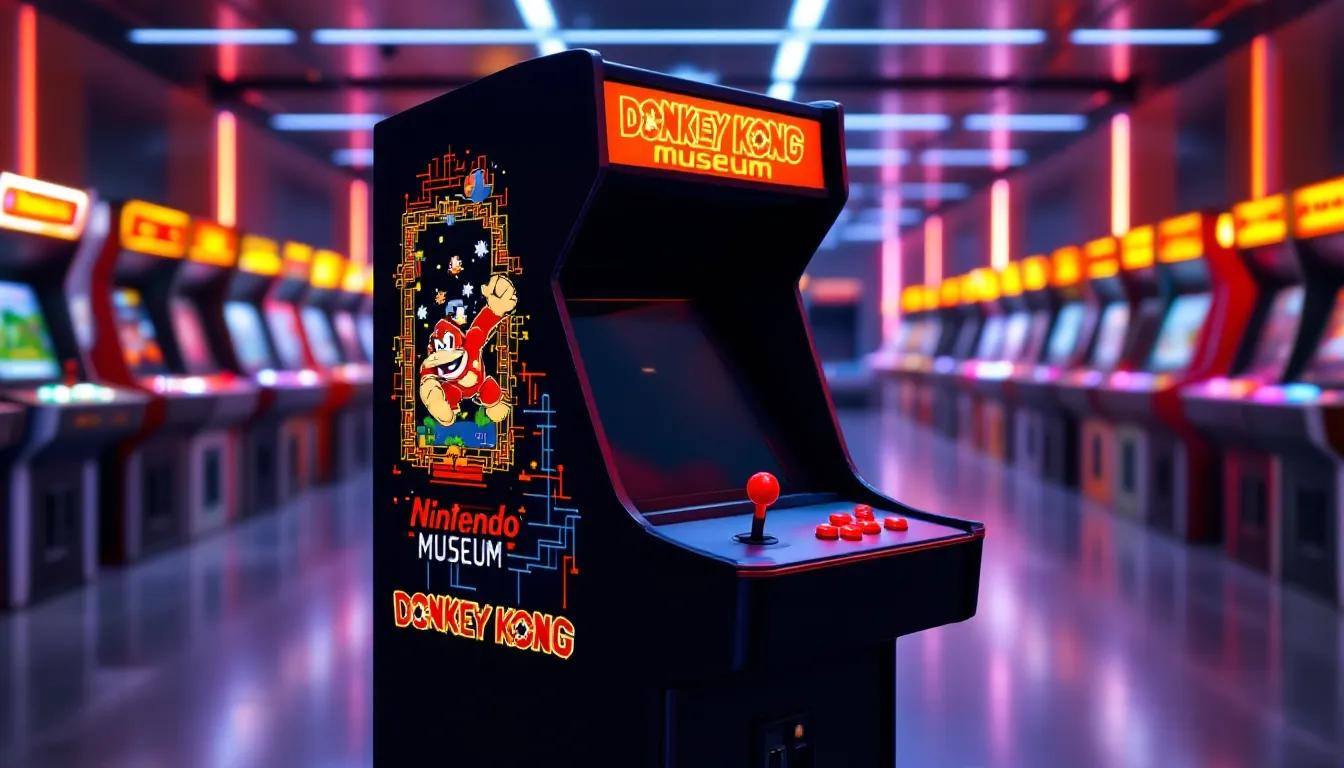
Before Mario became synonymous with home consoles, he was jumping barrels in dimly lit arcades across the globe. Nintendo’s arcade era might feel like ancient history to younger gamers, but it’s the foundation everything else was built on. These weren’t just quarter-munchers, they were the proving ground where Nintendo learned to craft tight gameplay loops, memorable characters, and experiences that kept players coming back for one more try.
The coin-op business was brutal. Games lived or died in weeks, not months. Nintendo didn’t just survive that environment, they dominated it with titles that are still referenced in game design courses today. Whether you’re chasing high scores on original cabinets or exploring emulation options, understanding Nintendo’s arcade legacy gives context to why modern gaming looks the way it does.
Key Takeaways
- Nintendo arcade games like Donkey Kong (1981) revolutionized gaming by introducing character-driven storytelling and tight gameplay mechanics that remain foundational to modern game design.
- Pattern recognition and boss design from Punch-Out.. established arcade design principles that influenced contemporary titles from Dark Souls to Cuphead.
- Nintendo strategically transitioned from arcades to home consoles in the mid-1980s, recognizing that recurring software revenue through the NES model far exceeded arcade hardware profits.
- Iconic Nintendo arcade games remain accessible today through official re-releases like Arcade Archives on Switch, MAME emulation, and licensed replica cabinets from Arcade1Up, preserving the arcade legacy for modern players.
- Original Nintendo arcade cabinets have become valuable collector’s items, with rare machines like Sky Skipper commanding premium prices exceeding $15,000 due to scarcity and historical significance.
- Mario Bros. (1983) pioneered cooperative and competitive multiplayer gameplay with emergent mechanics that established design patterns still relevant in modern arcade-style and indie games.
The History of Nintendo’s Arcade Legacy
Nintendo didn’t spring into existence as a gaming company. Their path to arcade dominance took decades of iteration, pivots, and a willingness to chase emerging markets.
From Hanafuda Cards to Coin-Operated Machines
Founded in 1889 as a playing card company in Kyoto, Nintendo spent most of the 20th century experimenting with various ventures, toys, taxi services, instant rice, even a love hotel chain. Nothing stuck quite like playing cards, but by the 1960s, president Hiroshi Yamauchi knew diversification was critical.
The leap into electronics came gradually. In the early 1970s, Nintendo secured rights to distribute the Magnavox Odyssey in Japan, which exposed them to the emerging video game market. Engineer Gunpei Yokoi developed the Ultra Hand toy in 1966, proving Nintendo had creative talent capable of designing hit products. By 1973, Nintendo was producing their own light gun shooting galleries for arcades, mechanical affairs that were more carnival game than video game.
The real shift happened when Yamauchi hired a young artist named Shigeru Miyamoto in 1977 and tasked him with saving a failing arcade project. That project would become Donkey Kong. But before that breakthrough, Nintendo cut its teeth on games like Sheriff (1979) and Radar Scope (1980), learning the coin-op business through trial and error.
Nintendo’s Golden Age in the Arcade (1970s-1980s)
The late ’70s and early ’80s were arcade boom years. Pac-Man, Space Invaders, and Asteroids were printing money. Nintendo wanted in, but their early efforts like Radar Scope flopped in Western markets even though decent Japanese performance.
Then came Donkey Kong in 1981, and everything changed. The game moved 65,000 cabinets in its first year in North America alone, a staggering number that established Nintendo as a legitimate arcade powerhouse. More importantly, it introduced Mario (then called Jumpman) and proved that character-driven narratives could work in arcade games.
Nintendo capitalized on this momentum with Donkey Kong Jr. (1982), Popeye (1982), and Mario Bros. (1983). Each title refined their design philosophy: clear objectives, escalating difficulty, and gameplay that was easy to learn but hard to master. The classic arcade design principles they established influenced everything from platformers to puzzle games.
By 1984, with titles like Punch-Out.. utilizing dual-screen technology, Nintendo was pushing technical boundaries. But the writing was on the wall, the arcade bubble was deflating, and home consoles represented the future. Nintendo’s arcade division would slow considerably after 1985, with their focus shifting entirely to the NES and handheld markets.
The Most Iconic Nintendo Arcade Games of All Time
Some arcade games fade into obscurity. Others define entire genres. Nintendo’s best coin-op efforts fall squarely in the latter category.
Donkey Kong (1981): The Game That Changed Everything
Donkey Kong wasn’t just a hit, it was a paradigm shift. Before this, most arcade games focused on abstract shooting or maze navigation. Miyamoto introduced a damsel-in-distress narrative structure with actual characters players could recognize and care about. Jumpman (later Mario), Pauline, and the titular ape weren’t just sprites, they had personality conveyed through animation and behavior.
Gameplay-wise, Donkey Kong introduced platforming as a core mechanic. Players had to time jumps over barrels, navigate moving platforms, and adapt to four distinct stage layouts that escalated in difficulty. The 25m, 50m, 75m, and 100m stages each presented unique challenges, keeping the gameplay fresh longer than most contemporaries.
The game’s impact was immediate. It generated over $280 million in its first two years, roughly $900 million adjusted for inflation. It launched Nintendo of America as a viable entity and gave the company their first true mascot. Speedrunners still chase world records on original hardware in 2026, with the current high score sitting at over 1.2 million points.
Mario Bros. (1983): The Birth of a Legendary Partnership
Mario Bros. is often overshadowed by its sequel Super Mario Bros., but the arcade original deserves recognition for establishing core elements of the Mario universe. This was the first game to name Mario explicitly and introduce his brother Luigi as a playable character.
The gameplay loop was simple but addictive: creatures emerged from pipes at the top of the screen, and players had to bump platforms from below to flip enemies, then kick them away before they recovered. Timing was everything, hit a platform too early or too late, and you’d take damage. The POW block added a screen-clearing mechanic that required strategic resource management.
What made Mario Bros. special was its cooperative play. Two players could work together or compete for points, creating emergent gameplay moments that weren’t scripted. You could accidentally (or intentionally) bounce your partner into an enemy, leading to arcade cabinet arguments that are legendary to this day.
The game’s phase structure, Turtle, Crab, Fighter Fly, kept the challenge escalating while maintaining the core mechanics. It sold 30,000 cabinets in the US and became a staple in pizza parlors and bowling alleys throughout the ’80s.
Punch-Out.. (1984): Boxing Innovation at Its Finest
Punch-Out.. was Nintendo’s technical showcase, featuring a dual-screen cabinet with separate displays for stats and action. The lower screen showed the match from a behind-the-boxer perspective, while the upper screen displayed opponent close-ups and vital information.
Gameplay centered on pattern recognition. Each opponent telegraphed their attacks through specific animations or facial expressions. Players had to watch for these tells, dodge or block accordingly, then counter during the brief opening. It was less about button-mashing and more about learning each fighter’s rhythm, a design philosophy that would influence boss battles across gaming for decades.
Characters like Glass Joe, Bald Bull, and Mr. Sandman had distinct personalities conveyed through animation and behavior. The game’s difficulty curve was steep but fair, losses felt earned, and victories felt like genuine accomplishments.
The arcade version of Punch-Out.. differs significantly from the later NES adaptation. The dual-screen setup allowed for more dramatic presentation, and the opponent roster included fighters that didn’t make it to home versions due to licensing or space constraints. Original cabinets are rare collector’s items today, often selling for $3,000-$8,000 depending on condition.
Other Notable Nintendo Arcade Classics
Beyond the big three, Nintendo released several arcade titles worth acknowledging:
- Donkey Kong Jr. (1982): Flipped the script by making the ape’s son the hero trying to rescue his father from Mario. Introduced vine-climbing mechanics and sold nearly 30,000 units.
- Popeye (1982): Licensed title that many believe was originally planned as a Donkey Kong sequel before Nintendo secured the Popeye license. Solid platforming with collect-the-items gameplay.
- Donkey Kong 3 (1983): A bizarre shooter hybrid where Stanley the Bugman sprays insects while Donkey Kong hangs from vines. It’s the weird cousin nobody talks about, but it has its fans.
- VS. System Games (1984-1986): Nintendo’s VS. System allowed arcade operators to swap game boards in standardized cabinets. Titles included VS. Super Mario Bros., VS. Excitebike, and VS. Duck Hunt, bringing home console experiences to arcades with modified difficulty.
- Sky Skipper (1981): A rare title that saw extremely limited release, only a handful of cabinets exist today, making it one of the most sought-after collectibles in arcade history.
How Nintendo Arcade Games Influenced Modern Gaming
Nintendo’s arcade catalog didn’t just entertain, it established design principles that ripple through modern game development.
Pioneering Character-Driven Storytelling
Before Donkey Kong, arcade games were largely abstract. Space Invaders had aliens. Pac-Man had a yellow circle. Context was minimal because processing power and ROM space were at a premium. Miyamoto changed that by prioritizing character and narrative, even in a medium designed for three-minute play sessions.
Mario’s animations in Donkey Kong conveyed emotion, he looked worried when Pauline was in danger, celebrated when he reached her. These tiny details created player investment beyond chasing high scores. This character-first approach became Nintendo’s calling card, influencing everything from The Legend of Zelda to Animal Crossing.
Modern indie games owe a debt to this philosophy. Titles like Celeste, Hollow Knight, and Cuphead prioritize character personality and environmental storytelling in ways that trace directly back to Nintendo’s arcade experiments. The industry learned that players connect more deeply with games when they care about who they’re controlling.
Innovative Gameplay Mechanics That Still Resonate Today
Nintendo’s arcade titles introduced or refined mechanics that modern designers still reference:
- Jump physics in Donkey Kong: The arc, timing, and momentum of Mario’s jump became the blueprint for platformers. Developers still cite it when tuning character movement.
- Pattern-based boss fights in Punch-Out..: The telegraph-and-counter rhythm influenced everything from Dark Souls to Cuphead. Recognizing patterns and exploiting openings is now fundamental boss design.
- Environmental hazards as primary threat: Mario Bros. made enemies secondary to platform timing and spatial awareness. Games like Celeste follow this model, where the level itself is the antagonist.
- Escalating difficulty within consistent mechanics: Nintendo arcade games didn’t introduce new rules mid-playthrough, they ramped up speed and complexity within established systems. This design respect for player learning still defines quality arcade-style experiences.
According to Gematsu, Japanese developers frequently cite Nintendo’s arcade era when discussing foundational game design. The lessons learned in coin-op competition, clear feedback, tight controls, immediate gratification, remain relevant even in live-service and mobile markets.
Playing Nintendo Arcade Games Today
The arcade era ended decades ago, but these games aren’t lost to time. Multiple avenues exist for experiencing Nintendo’s coin-op classics in 2026.
Arcade Emulation and Legal Options
Emulation remains the most accessible entry point for most players. MAME (Multiple Arcade Machine Emulator) has supported Nintendo arcade titles for over two decades, with near-perfect accuracy on titles like Donkey Kong, Mario Bros., and Punch-Out...
The legal status of emulation is nuanced. MAME itself is legal, it’s the ROMs (game files) where things get murky. Nintendo has never officially licensed their arcade ROMs for distribution, meaning downloads exist in a legal gray area. Some collectors argue that owning original PCBs grants legal backup rights, but that position has never been tested in court.
For players seeking above-board options, Arcade1Up produces licensed replica cabinets featuring Nintendo arcade classics. Their Donkey Kong cabinet (currently $399.99) includes the original trilogy in a 3/4-scale form factor with authentic artwork. These aren’t perfect, purists note differences in display refresh rates and control response, but they’re legitimate and convenient for home use.
Retro gaming expos and barcades occasionally feature original Nintendo cabinets on free-play or quarter-operated models. Checking local retro gaming communities often reveals rotating locations where original hardware can be experienced.
Nintendo Switch Online and Official Re-Releases
Nintendo Switch Online included Donkey Kong and Mario Bros. as part of its NES library, but these are the NES ports, not arcade-perfect versions. The differences are significant: screen layouts, difficulty balance, and graphical details vary from the coin-op originals.
In 2022, Nintendo released Arcade Archives versions of several titles through Hamster Corporation. These include:
- Donkey Kong (Arcade Archives, $7.99)
- Mario Bros. (Arcade Archives, $7.99)
- VS. Super Mario Bros. (Arcade Archives, $7.99)
These versions offer arcade-accurate emulation with added features like online leaderboards, adjustable difficulty, and screen customization. They’re the most legitimate way to play arcade versions on modern hardware.
Worth noting: Punch-Out.. has never received an official arcade re-release, likely due to licensing complexities with the character likenesses. The Wii version featured similar gameplay but completely different presentation and opponent rosters. For players exploring Nintendo Switch shooter experiences or other modern takes on classic genres, the Switch eShop offers various options that echo arcade design principles.
Finding Original Arcade Cabinets
Original Nintendo arcade cabinets have become collector’s items, with prices reflecting rarity and condition. Here’s what the market looks like in 2026:
- Donkey Kong (standard upright): $2,000-$4,500 depending on condition and originality
- Mario Bros.: $1,500-$3,000
- Punch-Out.. (dual-screen): $3,000-$8,000+ (extremely rare)
- Donkey Kong Jr.: $1,800-$3,500
- Sky Skipper: $15,000+ (fewer than 10 known cabinets exist)
Sourcing options include:
- Auction sites: eBay regularly features cabinets, but shipping costs are brutal, expect $300-$800 for cross-country transport.
- Arcade collector forums: Communities like KLOV (Killer List of Videogames) maintain marketplace sections where collectors buy, sell, and trade.
- Estate sales and storage auctions: Occasionally produce cabinet finds, though this requires patience and luck.
- Restoration projects: Non-working or heavily damaged cabinets can be acquired for $500-$1,000, then restored through PCB repairs, monitor refurbishment, and new artwork.
Restoration and maintenance require specific skills. CRT monitors need periodic adjustments and eventual replacement. PCB boards can develop solder joint issues or capacitor failures. Control panels wear out and need new joysticks or buttons. Anyone considering cabinet ownership should budget time and money for ongoing upkeep.
The Rarest and Most Collectible Nintendo Arcade Machines
While Donkey Kong and Mario Bros. sold tens of thousands of units, several Nintendo arcade titles barely made it to market. These ultra-rare cabinets command premium prices and legendary status among collectors.
Sky Skipper (1981) tops the list. Nintendo produced only a handful of cabinets before pulling the plug due to poor location testing. The game featured a pilot rescuing animals from a gorilla (sound familiar?) using a biplane. Fewer than ten confirmed cabinets exist worldwide, with one selling at auction in 2019 for $18,000. Most collectors will never see one in person.
Radar Scope occupies an interesting position. While thousands of cabinets were manufactured for Japan, only about 1,000 made it to North America, and most of those were later converted to Donkey Kong cabinets when Radar Scope flopped. Finding an unconverted Radar Scope cabinet in 2026 is challenging, with values ranging from $2,500-$5,000 depending on condition.
Popeye cabinets, while not as rare as Sky Skipper, are increasingly difficult to find in original condition. Many were converted to other games or stripped for parts. Clean examples with original marquees and side art now fetch $2,000-$4,000.
Sheriff (1979), one of Nintendo’s earliest video games, featured Wild West gunfighting with trackball controls. Production numbers were low, and most cabinets have been lost to time or converted. Operational units are museum-piece rarities worth $3,000-$6,000.
The VS. System cabinets present a different collecting challenge. Because operators could swap game boards, finding a specific title in an original VS. cabinet isn’t technically rare, but finding one with pristine original artwork and an unmolested cabinet is increasingly difficult. Complete VS. Punch-Out.. systems (the VS. System version of the dual-screen game) are particularly sought after.
According to collectors active on Nintendo Life forums, the market for rare Nintendo arcade cabinets has heated up significantly in the past five years. Investment-minded buyers and museums are competing with traditional collectors, driving prices upward. Authentication is critical, reproduction parts and “Frankensteined” cabinets (built from parts of multiple machines) are common. Serious collectors often consult experts or arcade historians before major purchases.
Why Nintendo Left the Arcade Business
Nintendo’s arcade retreat wasn’t sudden, it was a strategic pivot driven by market realities and emerging opportunities.
The Rise of Home Consoles
The Nintendo Entertainment System launched in Japan as the Famicom in 1983, then in North America in 1985. Its success was immediate and profound. By 1988, the NES was in over 30 million homes worldwide, generating revenue that dwarfed arcade operations.
Home consoles offered Nintendo something arcades couldn’t: recurring revenue through software sales. Arcade games were one-time hardware sales to operators, with Nintendo seeing no profit from the quarters players fed into machines. The NES model, selling hardware at modest margins then profiting from game sales, proved far more lucrative.
Also, home consoles allowed Nintendo to control the entire ecosystem. They could license third-party developers, enforce quality standards through their Nintendo Seal of Quality, and build a brand identity that extended beyond individual games. The Nintendo legacy transformed from coin-op manufacturer to household name.
Development resources naturally followed the money. By 1985, Nintendo’s best designers, including Miyamoto, were focused entirely on NES titles. Super Mario Bros. (1985) demonstrated what was possible on home hardware, and it became clear that the creative ceiling was higher at home than in arcades.
Shifting Market Dynamics in the 1980s
The arcade industry was simultaneously imploding. The video game crash of 1983 devastated North American arcades, with thousands of locations closing. While Nintendo was somewhat insulated due to their arcade hits, the broader market contraction made future investment risky.
Home technology was rapidly catching up to arcade hardware. Early arcade games commanded attention because they offered experiences impossible at home. By the mid-’80s, the NES was delivering comparable graphics and sound, eroding arcades’ technical advantage. Why pay 25 cents per play when you could own a comparable experience outright?
Japanese gaming culture was also shifting. Arcades remained popular in Japan through the ’90s and beyond, but the market fragmented. Fighting games like Street Fighter II and Virtua Fighter became dominant, requiring hardware capabilities and competitive scenes Nintendo wasn’t positioned to chase. Companies like Capcom, SNK, and Sega filled that space more aggressively.
Nintendo released a few arcade titles after 1985, VS. System games continued through 1986, and they dabbled with PlayChoice-10 systems (arcade units playing NES games), but their heart wasn’t in it. The last significant Nintendo arcade release was VS. Super Mario Bros. in 1986. After that, their coin-op division effectively shut down.
The decision proved correct. The NES sold over 60 million units worldwide. The Game Boy, launched in 1989, sold 118 million. The arcade business, meanwhile, continued its slow decline through the ’90s and 2000s, with most Western locations closing by 2010. Insiders discussing the Nintendo Switch 2 note how Nintendo’s portable-console hybrid strategy traces back to lessons learned in the arcade era, focus on gameplay experience and brand loyalty rather than raw hardware specs.
Conclusion
Nintendo’s arcade run was brief but seismic. In less than a decade, they went from struggling toy company to industry titan, defining genres and establishing design philosophies that still guide game development today. Those quarter-eating cabinets weren’t just entertainment, they were R&D for an empire.
The irony is that Nintendo’s greatest arcade creation, Mario, became synonymous with home gaming. The character born in coin-op competition thrived precisely because Nintendo recognized when to pivot. They understood that arcades were a means, not an end, a testing ground for ideas that would flourish elsewhere.
For modern gamers, these classics remain accessible through emulation, official re-releases, and the occasional barcade visit. Whether you’re chasing high scores on original hardware or exploring these titles for historical context, they’re worth experiencing. The gameplay still holds up, and understanding where gaming started makes it easier to appreciate where it’s going.
Donkey Kong, Punch-Out.., and Mario Bros. weren’t just successful games, they were proof that tight design, memorable characters, and respect for player skill create timeless experiences. That lesson remains true whether you’re dropping quarters in 1983 or firing up your Switch in 2026.


