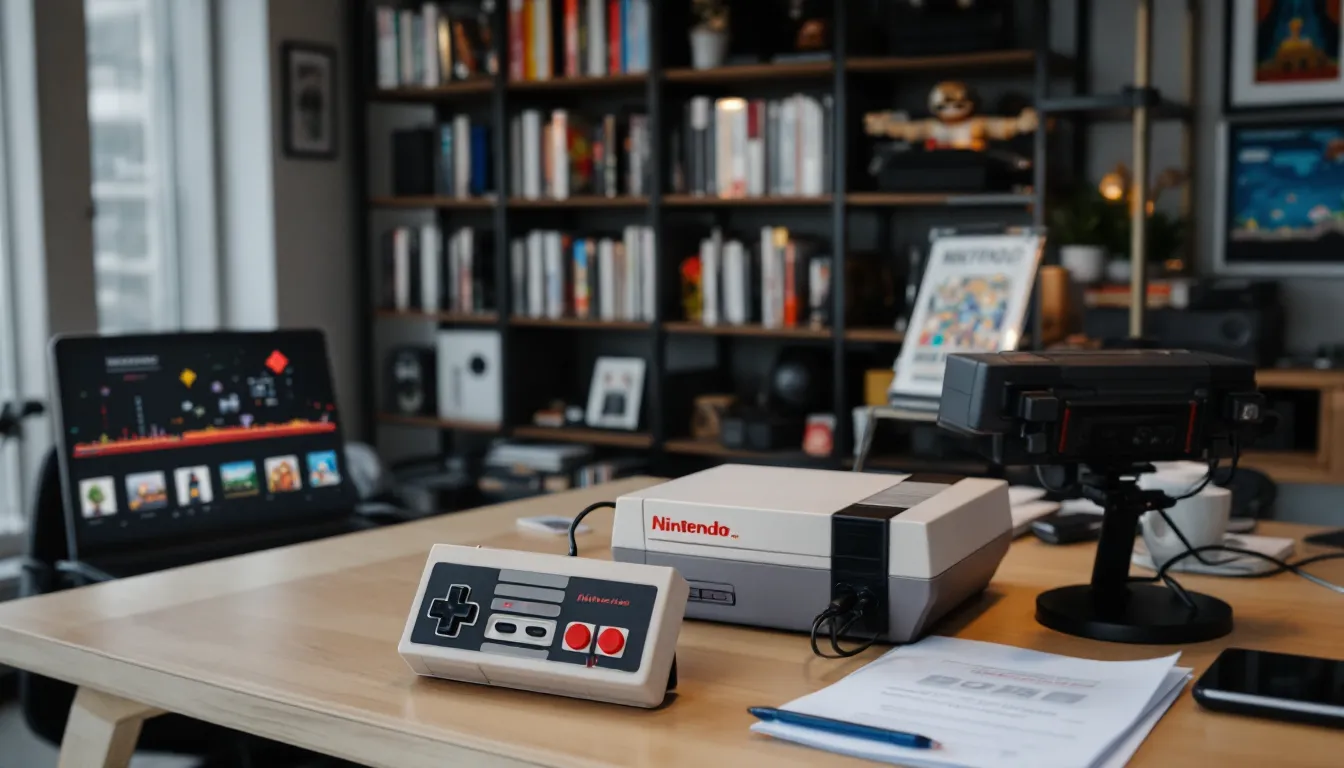
The Nintendo Entertainment System, better known as the NES, didn’t just sell consoles. It resurrected an entire industry from the ashes of the 1983 video game crash and redefined what home gaming could be. If you’ve ever wondered why a gray rectangular box from 1985 still commands respect in 2026, or if you’re looking to jump into retro gaming for the first time, this guide covers everything from the console’s architecture to where you can play its legendary library today.
Whether you’re a collector hunting down rare cartridges, a modern gamer curious about gaming’s roots, or someone who grew up blowing into cartridges and hoping for the best, the NES story is essential knowledge. Let’s break down what made this console a cultural phenomenon and why it still matters four decades later.
Key Takeaways
- The NES rescued the video game industry from the 1983 crash by combining strategic marketing, strict quality control through the Nintendo Seal of Quality, and an exceptional game library led by Super Mario Bros.
- The NES controller introduced the D-pad and A/B button layout that became the industry standard, proving that intuitive, simple design remains more influential than raw technological power.
- Iconic NES games like The Legend of Zelda, Metroid, and Super Mario Bros. established design paradigms that still define modern gaming across genres, from open-world exploration to ability-gating mechanics.
- In 2026, you can play NES games through Nintendo Switch Online ($19.99/year with 60+ titles), FPGA clone consoles like the Analogue Nt Mini, or original hardware found in retro stores for $80-150.
- Rare NES cartridges have become highly valuable collectibles, with titles like Nintendo World Championships Gold reaching $50,000-150,000, though authentication and avoiding reproductions is essential for serious collectors.
- The NES demonstrated that constraints breed creativity—with only 2KB of RAM, developers created masterpieces that prove timeless game design outweighs graphics and processing power.
What Is the NES and Why Does It Still Matter in 2026?
The Nintendo Entertainment System is an 8-bit home video game console released in North America in October 1985. Nintendo designed it as a trojan horse, disguising it as an “entertainment system” rather than a video game console to avoid the stigma left by the crash of ’83.
In 2026, the NES matters for three major reasons. First, it established design paradigms that still define gaming: the D-pad, the A/B button layout, side-scrolling platformers, password systems, and the concept of first-party quality control. Second, its library includes some of the most influential games ever made, titles that spawned multi-billion-dollar franchises. Third, it proved that gaming could be a sustainable, profitable industry when done right.
The NES sold over 61 million units worldwide during its lifespan. That’s not just a stat, it’s proof that Nintendo’s gamble paid off. The console introduced millions to characters like Mario, Link, Samus, and Mega Man, setting the template for IP-driven gaming that dominates today’s landscape.
For modern gamers, the NES represents gaming archaeology. Understanding its hardware limitations makes you appreciate how developers squeezed masterpieces from 2KB of RAM. The console’s influence echoes through indie games that deliberately mimic its aesthetic and through Nintendo’s ongoing commitment to gameplay over raw horsepower.
The History of the Nintendo Entertainment System
How Nintendo Saved the Video Game Industry
By 1983, the North American video game market had imploded. Atari’s market dominance crumbled under a flood of low-quality shovelware, retailers lost faith, and “video game” became a dirty word. The industry needed a savior, and Nintendo, already successful in Japan with the Famicom, stepped up.
Nintendo of America, led by Minoru Arakawa and Howard Lincoln, approached the U.S. market with surgical precision. They redesigned the Famicom into the NES, making it look more like a VCR than a toy. They included R.O.B. (Robotic Operating Buddy) and the Zapper light gun to position it as a “robotic entertainment system.”
The real genius was the Nintendo Seal of Quality. Nintendo implemented strict licensing agreements, controlling which games could be published and limiting third-party developers to five titles per year. This quality control prevented the shovelware epidemic that killed Atari. When retailers saw Nintendo’s curation strategy and the system’s lineup, especially Super Mario Bros. bundled with the console, they started believing again.
By 1988, the NES controlled 90% of the North American video game market. Nintendo didn’t just save the industry: they rebuilt it in their image.
Regional Differences: Famicom vs. NES
The Family Computer (Famicom) launched in Japan on July 15, 1983, two years before the NES reached America. The consoles shared the same core hardware but differed in crucial ways.
The Famicom sported red and white plastic, hardwired controllers with microphones built into Player 2’s controller, and a 60-pin cartridge slot. The NES featured gray and black industrial design, detachable controllers without microphones, and a 72-pin cartridge connector with a front-loading mechanism that looked like a VCR.
That front-loading design? It looked sleek but became the NES’s biggest hardware flaw. The zero-insertion-force mechanism wore out quickly, leading to the infamous blinking screen issue that spawned the cartridge-blowing ritual, a placebo that actually damaged pins over time.
The Famicom also had an expansion port on the front for accessories like the Famicom Disk System, which never came to the West. Regional lockout meant Japanese and American cartridges were physically incompatible, though converters eventually bridged that gap. Many Japanese games never saw Western release, and vice versa, creating two distinct gaming cultures around the same hardware.
Technical Specifications and Hardware Breakdown
Understanding the NES Architecture
The NES runs on a custom Ricoh 2A03 processor (based on the MOS Technology 6502) clocked at 1.79 MHz. For perspective, your smartphone’s processor runs thousands of times faster. The console had 2KB of RAM for general processing and 2KB of video RAM for graphics.
Graphics were handled by the Picture Processing Unit (PPU), capable of displaying 256×240 resolution with 52 colors available from a palette of 64. The system could show 25 colors simultaneously and handle up to 64 sprites on screen (with a limit of 8 per scanline, causing the infamous flickering in games like Contra).
Audio came from the 2A03’s built-in Programmable Sound Generator with five channels: two pulse waves, one triangle wave, one noise channel, and one sample channel. This limitation forced composers like Koji Kondo to become masters of constraint, creating unforgettable melodies from bleeps and bloops.
Many cartridges included mapper chips to expand the console’s capabilities. Games like Super Mario Bros. 3 and Mega Man used MMC3 chips to enable features like diagonal scrolling and extended ROM capacity. This cartridge-based expansion meant the NES’s capabilities grew throughout its lifespan without hardware revisions.
Controller Design and Innovation
The NES controller was revolutionary in its simplicity. The cross-shaped D-pad (directional pad) replaced joysticks and became the industry standard. Nintendo held the patent, but the design was so superior that competitors eventually licensed it or created workarounds.
The A and B button layout established the language of action gaming. A for jump, B for run/attack, muscle memory built on the NES transfers directly to modern controllers. The Start and Select buttons handled menu navigation and pausing, functions they still serve today.
The controller’s rectangular brick design fit comfortably in most hands even though looking utilitarian. The 6-foot cord allowed reasonable distance from the TV (though never quite enough). Third-party manufacturers like NES Advantage and NES Max offered alternatives, but Nintendo’s pack-in controller became the definitive way to play.
The controller connected via a proprietary 7-pin port. This locked-in design meant Nintendo controlled the accessory market and maintained quality standards, though it also meant you couldn’t easily use third-party options without Nintendo’s approval.
The Most Iconic NES Games Every Gamer Should Know
Super Mario Bros. and the Birth of Platform Gaming
Super Mario Bros. (1985) didn’t invent platformers, but it perfected them. Designer Shigeru Miyamoto crafted World 1-1 as a masterclass in teaching through gameplay, no tutorials, no hand-holding, just intuitive design that showed players what to do.
The game sold over 40 million copies, making it one of the best-selling games of all time. Its tight controls, hidden secrets (warp zones, coin rooms), and gradually increasing difficulty created a template that platformers still follow. The scroll-to-the-right structure, power-up system (Super Mushroom, Fire Flower, Star), and boss fights at the end of each castle defined the genre.
Mario himself became Nintendo’s mascot, eventually eclipsing Mickey Mouse in global recognition by the ’90s. The game’s success proved that character-driven, polished experiences could sell hardware. If you’re interested in modern Nintendo innovations, platforms focused on current offerings continue that legacy today.
The Legend of Zelda: Adventure Gaming Revolutionized
The Legend of Zelda (1986) introduced non-linear exploration to consoles. Players could tackle dungeons in various orders, discover secrets through experimentation, and experience genuine adventure in a fantasy world. The gold cartridge itself became iconic, a physical signal that this game was special.
The game featured battery-backed save memory, eliminating password systems for a seamless experience. Its open-world structure influenced everything from Dark Souls to Breath of the Wild. The core loop, explore, find items, unlock new areas, created a sense of discovery that few games had achieved.
Zelda proved that console games could be complex and deep, not just arcade-style score chasers. The franchise spawned over 20 mainline entries and became one of gaming’s most respected IPs. Link, though often confused with Zelda by non-gamers, stands as one of the medium’s most enduring heroes.
Other Must-Play NES Classics
The NES library runs deep. Here are essential titles that defined genres:
Metroid (1986) – Introduced Samus Aran and non-linear exploration with ability gating. The twist ending revealing Samus as a woman was groundbreaking for 1986.
Mega Man 2 (1988) – Perfected the stage-select formula and boss weapon system. Widely considered the best in the classic series with an incredible Capcom soundtrack.
Castlevania (1986) – Gothic horror meets tight platforming. The difficulty curve was brutal but fair, and the whip combat felt unique.
Contra (1987) – The definitive run-and-gun, famous for the Konami Code (↑↑↓↓←→←→BA) that gave players 30 lives. Co-op made it legendary.
Final Fantasy (1987) – Saved Squaresoft from bankruptcy and established JRPG conventions. Classes, turn-based combat, and epic scope defined the genre.
Punch-Out.. (1987) – Pattern recognition and timing perfected. Mike Tyson’s appearance made it a cultural phenomenon.
Ninja Gaiden (1988) – Cutscenes between levels brought cinematic storytelling to action games. Notoriously difficult but rewarding.
Many of these franchises remain active today, and discussions around recent Nintendo releases show how the company continues building on these foundations.
How to Play NES Games in 2026
Original Hardware: Finding and Maintaining Vintage Consoles
Original NES consoles are still available through retro game stores, eBay, Facebook Marketplace, and yard sales. Expect to pay $80-150 for a working console with cables and a controller, depending on condition. The top-loading NES-101 model (1993) is more reliable but pricier due to lower production numbers.
The main issue with original hardware is the 72-pin connector. After 35+ years, bent pins cause connection problems, the infamous flashing screen. Replacement connectors cost $10-15 and are relatively easy to install with basic tools. Cleaning cartridges with isopropyl alcohol (90%+) and Q-tips improves reliability more than blowing ever did.
You’ll need composite cables (yellow for video, red/white for audio) and a CRT TV for the authentic experience. Modern flat-screens add input lag and make light gun games like Duck Hunt completely unplayable since Zapper technology relied on CRT phosphor timing.
Maintenance tips: Store consoles in climate-controlled spaces, clean cartridge slots regularly, and never use excessive force when inserting games. The front-loader’s mechanism is fragile, treat it gently.
Nintendo Switch Online and Official Emulation
Nintendo’s official solution for playing NES games in 2026 is the Nintendo Switch Online service. For $19.99/year (Individual) or $34.99/year (Family), subscribers get access to a growing library of NES (and SNES) titles with added features.
The service includes over 60 NES games as of March 2026, including Super Mario Bros., The Legend of Zelda, Metroid, and Kirby’s Adventure. Nintendo adds games monthly, though the selection focuses on first-party titles and major third-party hits.
Features include:
- Save states at any point
- Rewind function to undo mistakes
- Online multiplayer for compatible games
- Special editions with enhanced features (like The Legend of Zelda starting with all items)
The Switch’s handheld mode makes it perfect for portable retro gaming. Image quality is sharp on modern displays, though purists might miss the CRT aesthetic. No input lag issues and seamless integration make this the most convenient legal option.
According to coverage from Nintendo Life, Nintendo continues expanding the library with fan-favorite titles, though licensing issues prevent some third-party classics from appearing.
Retro Gaming Alternatives and Clone Consoles
The retro gaming market exploded in the past decade with hardware and software alternatives:
Clone Consoles:
- Analogue Nt Mini Noir ($500+) – FPGA-based hardware that perfectly replicates NES behavior at the transistor level. Outputs HDMI with zero lag. Premium price but the ultimate experience for purists.
- RetroUSB AVS ($185) – FPGA clone with HDMI output and compatibility with original cartridges. Region-free and reliable.
- Hyperkin RetroN series ($50-100) – Budget clones with mixed compatibility. Hit-or-miss build quality but affordable entry point.
Emulation Options:
Software emulation on PC, smartphones, or devices like Raspberry Pi offers convenience and filtering options. Popular emulators include FCEUX, Mesen, and RetroArch (which supports multiple cores). Emulation accuracy has reached near-perfect levels, though legal ROM acquisition remains a gray area, you should only use ROMs of games you own physically.
Handheld emulation devices like the Anbernic RG353V or Steam Deck can run NES games flawlessly with customizable controls and save states. For those comparing modern portable options, perspectives on handheld gaming systems help contextualize the retro experience.
Official Mini Consoles:
Nintendo released the NES Classic Edition in 2016 (and again in 2018) with 30 pre-loaded games for $59.99. It’s been discontinued, but used units sell for $70-100. The tiny form factor and HDMI output made it a hit, though the short controller cables were a baffling design choice.
Collecting NES Games and Memorabilia
Most Valuable and Rare NES Games
The NES collecting market has exploded, with certain titles commanding four or five figures. Condition matters enormously, complete-in-box (CIB) copies with manual and inserts sell for multiples of cart-only prices.
Most Expensive NES Games (2026 market prices):
- Nintendo World Championships Gold – $50,000-150,000 depending on condition. Only 26 cartridges exist, given as contest prizes in 1990.
- Stadium Events – $10,000-40,000 CIB. Recalled shortly after release when Nintendo rebranded it as World Class Track Meet.
- Nintendo Campus Challenge 1991 – $20,000+. Competition cartridge with extremely limited availability.
- Little Samson – $1,200-3,000 CIB. Late-release title with low print run but excellent gameplay.
- Flintstones: Surprise at Dinosaur Peak – $1,000-2,500 CIB. Blockbuster exclusive with minimal distribution.
Other valuable titles include Bubble Bobble Part 2, Snow Brothers, Bonk’s Adventure, and Panic Restaurant. Most late-era releases (1993-1994) have smaller print runs since the Super Nintendo dominated the market by then.
Graded games, professionally authenticated and sealed in acrylic cases by WATA or CGC, command premium prices. A sealed copy of Super Mario Bros. sold for $2 million in 2021, though that market has cooled considerably amid controversy over artificial price inflation.
Tips for Building Your NES Collection
Start with goals. Are you collecting to play, for investment, or for completionism? Each approach requires different strategies.
Playing Collection:
Focus on quality over rarity. Buy loose cartridges of games you actually want to play. Test before buying when possible, dead batteries in save-enabled games require replacement. Budget $5-30 per common title, $30-100 for popular classics.
Investment Collection:
Target CIB copies of first-party Nintendo titles and popular franchises. Condition is everything, box corners, manual completeness, and cartridge label quality dramatically affect value. Store in acid-free protectors away from light and humidity.
Completionist Collection:
There are 677 officially licensed NES games in North America. Completing a full set requires serious dedication and a five-figure budget. Join communities like NintendoAge forums or Reddit’s /r/gamecollecting for advice.
Where to Buy:
- Local game stores offer tested cartridges with short return windows
- eBay provides the widest selection but buyer-beware applies
- Facebook Marketplace and Craigslist have deals but require knowledge to avoid fakes
- Conventions like PRGE (Portland Retro Gaming Expo) concentrate sellers in one place
Avoiding Reproductions:
Fake cartridges flood the market, especially for expensive titles. Learn to spot reproductions: check screw types (Nintendo used 3.8mm gamebit security screws), board stamps, and cartridge weight. Repositories like Gematsu occasionally cover retro gaming preservation efforts that help distinguish authentic from counterfeit hardware.
Authentication:
For expensive purchases ($200+), consider professional authentication or only buy from reputable dealers with return policies. Documentation and provenance increase value for rare titles.
The NES Legacy: Impact on Modern Gaming
The NES established principles that define gaming 40 years later. Nintendo’s emphasis on gameplay over graphics remains their philosophy, compare the Switch’s specs to PlayStation 5 and you’ll see they’re still following the NES playbook: fun trumps raw power.
The console proved that third-party relationships matter. Nintendo’s licensing program created a sustainable ecosystem where developers, publishers, and platform holders all profited. That model, with refinements, powers PlayStation, Xbox, and Steam today.
Character IP became king because of the NES. Mario, Link, and Samus generated merchandise, cartoons, and eventually movies (with mixed success until The Super Mario Bros. Movie in 2023 grossed over $1 billion). Gaming characters became cultural icons on par with film and television properties.
The NES established quality curation as a selling point. While modern platforms struggle with asset-flips and shovelware on digital stores, Nintendo’s original Seal of Quality demonstrated that consumers value curated experiences. Nintendo still maintains stricter submission standards than competitors.
Game design fundamentals from NES titles appear everywhere. Indie darlings like Celeste, Shovel Knight, and The Messenger explicitly reference 8-bit aesthetics and mechanics. Dark Souls borrowed Zelda’s stamina and exploration systems. Battle royales use the same risk-reward item hunt loop as Zelda dungeons.
Technically, the NES showed that constraints breed creativity. With 2KB of RAM, developers couldn’t waste resources on fluff, every byte mattered. Modern indies often self-impose restrictions to force creative solutions, a lesson learned from NES-era development.
The console’s longevity proves that good games age gracefully. Super Mario Bros. 3 plays as well today as in 1990. When Nintendo’s hardware approaches combine modern convenience with classic design, they’re acknowledging that the NES got fundamental things right.
The competitive speedrunning scene owes much to the NES. Games like Super Mario Bros., The Legend of Zelda, and Punch-Out.. remain staples at events like AGDQ (Awesome Games Done Quick). The precise, deterministic nature of NES games makes them perfect for optimization, runners execute frame-perfect tricks discovered through decades of community research.
Retro aesthetics in modern games aren’t just nostalgia, they’re recognition that the NES visual language communicates clearly. Pixel art conveys information efficiently, a design principle as relevant in 2026 as 1985. Coverage from outlets like Siliconera frequently highlights how Japanese developers continue drawing from Famicom-era design philosophy.
Conclusion
The NES didn’t just change gaming, it rescued it, reshaped it, and set standards that echo through every console generation since. From its strategic redesign to fool skeptical retailers to its legendary library of genre-defining games, the console proved that quality, curation, and innovation matter more than technological horsepower.
Whether you’re experiencing these games for the first time through Nintendo Switch Online, hunting down a pristine Stadium Events cartridge, or rebuilding an original console with replacement parts, the NES offers something unique. It’s a playable museum of gaming history, a reminder that creativity flourishes under constraints, and proof that great design is timeless.
The gray box that revived an industry remains relevant four decades later, not because of nostalgia, but because the games are still genuinely fun. That’s the real legacy of the Nintendo Entertainment System.