
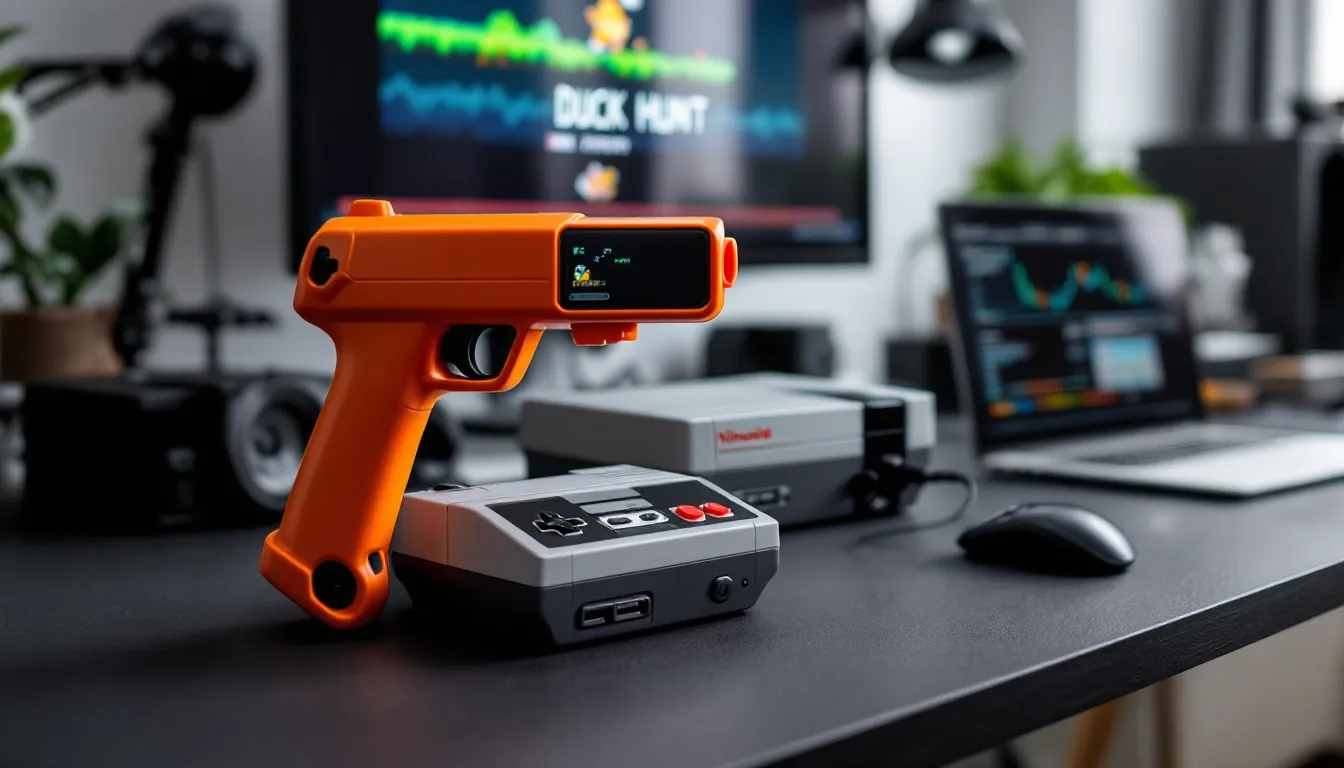
Few games spark instant recognition quite like Duck Hunt. The moment you hear that distinctive “ping” of a successful shot or see that smug dog laugh at your misses, you’re transported back to 1984. This wasn’t just another NES game, it was the title that introduced millions to light gun gaming and created one of the most enduring memes in gaming history decades before memes even existed online.
Whether you’re a retro gaming enthusiast trying to relive childhood memories, a speedrunner looking to master every duck pattern, or a curious newcomer wondering what all the fuss is about, this guide covers everything from the original CRT technology that made it work to how you can play it today on modern hardware. Duck Hunt’s deceptively simple gameplay hides surprising depth, and its legacy continues to influence gaming culture in 2026.
Key Takeaways
- Nintendo Duck Hunt, released in 1985 as an NES launch title, revolutionized gaming by introducing millions to light gun technology and became one of the best-selling games with over 28 million copies distributed.
- Duck Hunt’s simple gameplay—point, shoot, and retrieve—masks surprising depth, with competitive players today practicing frame-perfect aiming techniques, pattern recognition, and mental stamina to maintain 95%+ accuracy at maximum speeds.
- The game’s photodiode-based light gun detection system relies on CRT display technology that’s incompatible with modern LCD and OLED televisions, making authentic Duck Hunt play increasingly rare and valuable to retro collectors.
- The mocking dog has transcended the original game to become gaming’s first viral moment and internet meme, evolving into a playable fighter in Super Smash Bros. where players finally gained the ability to defeat the iconic troll.
- Playing Nintendo Duck Hunt authentically today requires sourcing rare original hardware—NES console, Zapper light gun, and functional CRT television—though emulation and mouse-based alternatives offer limited modern accessibility.
- Duck Hunt’s 40-year legacy continues shaping gaming culture in 2026 through speedrunning competitions, high-score leaderboards, and cultural references, proving that simple, well-designed mechanics create timeless appeal regardless of technological advancement.
What Is Duck Hunt and Why Is It Still Legendary?
Duck Hunt is a light gun shooter developed and published by Nintendo for the Nintendo Entertainment System (NES). Released in North America in October 1985 as a launch title, the game challenged players to shoot ducks (and later clay pigeons) that flew across the screen using the NES Zapper, a light gun peripheral shaped like a futuristic pistol.
The premise couldn’t be simpler: ducks fly up from the grass, you have three shots to bring them down, and a hunting dog retrieves your kills or mocks your failures. Yet this simplicity became its strength. Duck Hunt required no tutorial, no complex button combinations, just point and shoot.
What makes Duck Hunt legendary decades later? First, accessibility. The game was bundled with millions of NES consoles alongside Super Mario Bros., making it one of the best-selling games of all time with over 28 million copies distributed. An entire generation’s first gaming experience involved holding that orange Zapper.
Second, the dog. That pixelated canine’s mocking laugh when you missed became etched into collective gaming consciousness. Before Twitch emotes and Reddit threads, this was perhaps gaming’s first truly viral moment, a shared frustration that united players across continents.
Third, the technology itself felt magical. In an era when most games used controllers, physically aiming at your TV screen and pulling a trigger created an immersive experience that still feels novel. The fact that this technology is now incompatible with modern displays only adds to its mystique and collector appeal.
The Birth of Duck Hunt: Development and Release History
From Nintendo’s Toy Division to the NES
Duck Hunt’s DNA traces back to Nintendo’s pre-video game days as a toy company. In 1976, Nintendo released the Laser Clay Shooting System, an electro-mechanical arcade game where players shot at clay pigeon projections in converted bowling alleys across Japan. While ambitious, the system proved too expensive to maintain during Japan’s economic downturn.
Designer Gunpei Yokoi, the legendary creator behind the Game Boy, saw potential in miniaturizing this concept for home use. Working with Nintendo’s R&D1 division, Yokoi developed several light gun toys throughout the late 1970s, including the Beam Gun series. These toys used the same photodiode detection technology that would later power Duck Hunt.
When Nintendo shifted focus to the Famicom (known as the NES internationally), Yokoi’s team adapted their light gun technology for the new console. Duck Hunt was initially released in Japan for the Famicom on April 21, 1984, packaged with the orange Zapper light gun. The game’s development took advantage of the Famicom’s capability to synchronize screen output with controller input at precise microsecond intervals.
The Bundle That Changed Gaming Forever
Nintendo’s North American launch strategy in 1985 was make-or-break. The video game crash of 1983 had devastated the industry, with retailers refusing to stock game consoles. Nintendo marketed the NES as an “Entertainment System” rather than a game console, positioning it alongside VCRs and stereos.
The Action Set bundle became their secret weapon. For $149.99, consumers received the NES console, two controllers, the Zapper light gun, Super Mario Bros., and Duck Hunt on a single cartridge. This bundle accounted for the majority of NES sales through the late 1980s.
The bundling strategy was brilliant marketing. Super Mario Bros. showcased the NES’s platforming capabilities and controller precision. Duck Hunt demonstrated an entirely different play style, proving the system’s versatility. Parents saw value in two games plus unique peripherals, while kids got variety.
By 1990, the Action Set had helped Nintendo capture 90% of the North American home console market. Duck Hunt’s role as the “second game” in millions of homes made it one of gaming’s most-played titles, even if players spent more total hours on Mario.
How Duck Hunt Gameplay Actually Works
Game Modes Explained: One Duck, Two Ducks, and Clay Shooting
Duck Hunt offers three distinct game modes, selectable from the title screen using the NES controller:
Game A: One Duck – A single duck appears per round, flying in various patterns across the screen. Players get three shots to bring it down. This mode is ideal for beginners and for practicing specific aiming techniques. Ducks move faster as rounds progress, with noticeable speed increases every few levels.
Game B: Two Ducks – The real challenge. Two ducks appear simultaneously, often flying in opposite directions or crossing paths. Players still get three total shots, meaning perfect accuracy is required to clear higher rounds. Missing both ducks burns through attempts quickly. This mode separates casual players from serious competitors and is the standard for speedrunning.
Game C: Clay Shooting – Instead of ducks, clay pigeons launch from ground-level throwers at the screen’s bottom corners. Clays follow predictable arcing trajectories but move faster than ducks in early rounds. The rhythm differs significantly from duck hunting, it’s more about timing the arc than tracking erratic movement. Clay shooting receives less attention than the duck modes but offers a legitimate challenge at higher speeds.
Each mode features a progression system where difficulty increases every few rounds. There’s no final boss, no ending sequence, just incrementally faster targets until you fail.
The Scoring System and Round Progression
Duck Hunt’s scoring system rewards both accuracy and progression:
- Round 1: Ducks move at base speed, worth 500 points each when hit
- Rounds 2-5: Slight speed increase, points remain 500
- Rounds 6-10: Noticeable speed boost, points increase to 800
- Rounds 11-15: Ducks become significantly faster, worth 1,000 points
- Round 16+: Maximum speed maintained, points remain 1,000
Players must shoot a minimum number of ducks per round to advance. Early rounds require hitting just 5 out of 10 ducks. By round 10, the requirement jumps to 8 out of 10. Round 15 and beyond demand nearly perfect accuracy, missing more than one or two means game over.
The game tracks your hit ratio, displaying it between rounds. This percentage becomes a point of pride for skilled players. Maintaining 90%+ accuracy through round 20 requires genuine mastery.
One quirk: the game doesn’t save high scores. Your score vanishes when you power off, making Duck Hunt a purely in-the-moment competition. This actually enhanced its social nature, bragging rights required witnesses.
The NES Zapper: Technology Behind the Light Gun
How the Light Gun Technology Detects Targets
The NES Zapper seems like magic, but the technology is elegantly simple. When you pull the trigger, a precise sequence occurs in milliseconds:
- The screen goes completely black for one frame (about 16.7 milliseconds on NTSC systems)
- The game draws white rectangles where valid targets (ducks or clays) are positioned
- A photodiode in the Zapper barrel detects whether it’s pointed at a white rectangle or black space
- The NES registers a hit or miss based on light detection
- Normal gameplay resumes before players consciously notice the blackout
This happens so fast that most players never consciously see the black frame, though it’s visible if you’re watching for it or viewing slow-motion footage. The photodiode acts like a simple eye, it only knows “light” or “no light.”
For multiple targets in Game B’s two-duck mode, the system draws rectangles sequentially, checking which one (if any) the Zapper was aimed at. This is why the Zapper can distinguish between two ducks even though having no positional tracking, the timing of light detection reveals which target you were aiming at.
One infamous exploit: pointing the Zapper at a light bulb and pulling the trigger registers as a hit, since the photodiode detects light. Savvy players discovered this quickly, though it defeats the entire purpose of playing.
Why Duck Hunt Doesn’t Work on Modern TVs
Here’s the frustrating truth for retro enthusiasts: Duck Hunt is fundamentally incompatible with LCD, LED, OLED, and plasma displays. The game requires a CRT (cathode ray tube) television to function.
The reason comes down to display technology differences:
CRT displays use an electron gun that draws the image line-by-line from top to bottom, completing a full frame in about 16.7ms. When the NES tells the screen to go black, it happens instantly at the hardware level. When it draws white target rectangles, they appear immediately. The Zapper’s photodiode can detect these changes within the precise timing window the game expects.
Modern flat-panel displays have inherent processing lag. The LCD panel doesn’t change pixel states instantly, there’s liquid crystal response time, backlight adjustment, and image processing. Even in “game mode” with processing minimized, modern TVs typically add 15-50ms of input lag. This delay breaks the Zapper’s timing-dependent detection system.
Also, modern displays don’t draw images the same way. There’s no electron gun scanning line-by-line: instead, the entire panel updates at once after processing. The synchronization between NES output and light detection that Duck Hunt relies on simply doesn’t exist.
Some modders have created solutions involving CRT monitors connected to upscalers or FPGA-based systems, but these are complex workarounds. For authentic Duck Hunt gameplay, a period-appropriate CRT remains mandatory, which is why working CRTs have become increasingly valuable to retro collectors.
That Annoying Dog: The Internet’s First Gaming Meme
Before rage comics, before Leeroy Jenkins, before “All your base are belong to us,” there was the Duck Hunt dog’s mocking laugh. This 8-bit canine became gaming’s original troll, generations before internet culture gave us a vocabulary for such things.
The dog serves two functions in gameplay. When you successfully shoot a duck, he happily retrieves it, holding it up with a cheerful expression. When you miss all three shots, he pops up from the grass with that infamous grin and laugh, a digitized chuckle that sounds almost gleeful about your failure.
That laugh became iconic specifically because it felt personal. The game wasn’t just registering your miss with a generic “game over” sound: it was rubbing your face in it. Players developed genuine emotional relationships with this pixelated dog, ranging from amused affection to seething hatred.
The dog’s laugh spawned countless parodies, remixes, and references across gaming culture. YouTube features hundreds of Duck Hunt dog remixes. The character appears in internet memes decades after the game’s release. In 2026, streamers still use the laugh as a sound alert for failed attempts or subscriber trolling.
Can You Actually Shoot the Dog?
This is perhaps the most frequently asked Duck Hunt question, born from decades of player frustration. The short answer: No, you cannot shoot the dog in the original NES version.
The dog exists in a protected layer of the game’s code. When he appears on screen, the game doesn’t register his sprite as a valid target. Pull the trigger while the Zapper is pointed at him, and nothing happens. No hit detection, no reaction, no satisfaction. Nintendo programmed this limitation intentionally, the dog is untouchable.
This invincibility only amplified player frustration and the character’s legendary status. There’s something deeply aggravating about a target that mocks you while remaining immune to retaliation. Gaming forums and playground discussions buzzed with rumors of secret codes or techniques to shoot the dog, but these were all urban legends.
Interestingly, when the dog appeared as a playable fighter in Super Smash Bros. for Wii U/3DS (2014) and Super Smash Bros. Ultimate (2018), players finally got their revenge. The Duck Hunt duo (dog + duck) can absolutely be beaten, launched, and KO’d in Smash Bros., providing cathartic release for players who’d waited 30+ years.
Some ROM hacks and modified versions of Duck Hunt have added the ability to shoot the dog, often with humorous results. These fan-made versions circulate in emulation communities but aren’t official Nintendo products. For purists playing on original hardware, the dog remains eternally, frustratingly safe.
Advanced Tips and Strategies for High Scores
Optimal Aiming Techniques and Reaction Training
Mastering Duck Hunt requires more than just pointing and shooting. Competitive players and speedrunners have refined techniques that drastically improve accuracy:
Pre-aim the launch zones: Ducks always emerge from specific grass locations at the screen’s bottom. Position the Zapper at these spawn points before ducks appear. When they launch, you’re already on target rather than tracking from wherever your last shot ended. This shaves crucial milliseconds off reaction time.
Use peripheral vision: Don’t tunnel-vision on where you’re aiming. Keep your focus soft and wide, allowing peripheral vision to catch duck movement. Your brain processes motion in peripheral vision faster than focused central vision, improving reaction speed.
Trigger discipline matters: The Zapper’s trigger has a distinct pull weight and click point. Learn exactly where the trigger breaks so you can pull smoothly without jerking the gun off-target. Anticipating the trigger break prevents last-millisecond aim disruption.
The two-duck priority system: In Game B mode with two ducks, always shoot the faster or more erratic duck first. If one duck is flying straight while the other zigzags, eliminate the unpredictable threat. Similarly, shoot the duck traveling toward screen edges first, once they escape off-screen, they’re gone.
Distance from screen: Sitting too far reduces accuracy due to hand tremor becoming proportionally larger movements on screen. But, being too close limits peripheral vision and makes tracking crossing ducks harder. Most competitive players sit 4-6 feet from the TV, though several Nintendo Switch shooter games have tested how modern players adapt these distances with different control schemes.
Practice with purpose: Don’t just play rounds mindlessly. Focus practice sessions on specific weaknesses. Missing diagonal flights? Spend a session only shooting at specific angles. Struggling with round 15+ speed? Use Game C’s clay shooting to train reaction time at high velocities.
Understanding Duck Patterns and Speed Increases
Duck Hunt’s ducks aren’t completely random, they follow semi-predictable patterns that skilled players learn to exploit:
Launch patterns: Ducks spawn from three grass locations: left, center, and right. While which position spawns a duck is randomized, the flight path from each position tends toward certain directions. Left-spawn ducks frequently fly right initially: center-spawn often goes vertical or diagonal.
Flight behavior types: Ducks exhibit several flight personalities:
- Straight fliers: Maintain consistent direction and speed, easiest targets
- Zigzaggers: Change direction every second or two in sharp angles
- Circulars: Fly in arcing patterns, often returning near spawn points
- Escape artists: Make a beeline for screen edges with minimal deviation
Speed thresholds: The game increases duck speed at specific round intervals:
- Rounds 1-5: Base speed, approximately 2-3 pixels per frame
- Rounds 6-10: ~25% speed increase
- Rounds 11-15: ~50% increase from base
- Round 16+: Maximum speed, roughly double base velocity
Beyond round 20, no further speed increases occur, the challenge becomes purely about maintaining concentration and accuracy under sustained pressure.
The RNG seed quirk: Duck Hunt’s random number generation isn’t truly random but pseudorandom based on the console’s power-on state. Speedrunners have discovered that specific power-cycling sequences can manipulate early duck patterns, leading to more favorable spawns. This technique, called “duck manipulation,” shaves seconds off speedrun times but requires frame-perfect timing.
High-round survival: Past round 25, fatigue becomes the real enemy. Physical stamina matters, your arm gets tired holding the Zapper extended, and mental fatigue causes reaction times to slip. Top players report their peak accuracy occurs between rounds 15-25, before fatigue sets in but after the initial warm-up.
The current verified high score record for Duck Hunt Game B mode exceeds 999,999 points (the game’s score counter maxes out), achieved through marathon sessions lasting several hours with near-perfect accuracy maintained across hundreds of rounds.
Duck Hunt’s Cultural Impact and Legacy
From NES Classic to Super Smash Bros Appearances
Duck Hunt’s influence extends far beyond its original NES release, cementing its place in gaming’s cultural pantheon through numerous re-releases and crossover appearances.
Nintendo included Duck Hunt in the NES Classic Edition (2016) and NES Classic Edition (2018 re-release), miniature plug-and-play consoles preloaded with 30 NES games. But, these versions are essentially unplayable since they connect to modern HDTVs via HDMI, the light gun doesn’t function. Players can select the game and watch the demo, but actually playing requires using the controller to select menu options, which the original game doesn’t support. It’s a bittersweet inclusion that highlights the technological gap between eras.
The Duck Hunt dog made his biggest comeback in Super Smash Bros. for Nintendo 3DS and Wii U (2014), appearing as a playable fighter simply called “Duck Hunt.” The character is actually a trio: the dog, a duck, and occasionally a retro Zapper-wielding shooter who appears for certain attacks. This fighter represents not just Duck Hunt but Nintendo’s entire light gun legacy.
Duck Hunt’s moveset in Smash Bros. brilliantly references the original game:
- Neutral B: Shoots the Zapper at a can, which players can repeatedly shoot to control trajectory
- Side B: Deploys the clay pigeon from Game C mode as a projectile
- Up B: Ducks carry the dog upward while the Zapper shooter fires at them
- Final Smash: Summons an entire flock of 8-bit ducks from the original game
The character’s inclusion sparked nostalgia-fueled enthusiasm when revealed in 2014. Older players who grew up with Duck Hunt got to finally control (and beat up) the infamous mocking dog, while younger Smash players discovered a piece of Nintendo history.
Duck Hunt also appears in various forms across Nintendo’s ecosystem. The dog is an unlockable spirit in Smash Bros. Ultimate, a costume element in Super Mario Maker 2, and has been referenced in WarioWare microgame collections. Each appearance reinforces the game’s status as Nintendo cultural heritage rather than a forgotten relic, according to retrospectives on platforms like IGN.
Speedrunning and Competitive Duck Hunt in 2026
While Duck Hunt might seem too simple for competitive play, a dedicated speedrunning and high-score community thrives in 2026. These players treat the 1984 game with the same analytical rigor applied to modern esports.
Speedrun categories for Duck Hunt include:
Game A – Round 20: The standard category. Players race to complete round 20 in Game A (one duck) as quickly as possible. World record times hover around 11-12 minutes, with frame-perfect shots and zero misses required. The RNG manipulation techniques mentioned earlier are legal in most category rules.
Game B – Max Score: A marathon endurance category where players attempt to achieve the maximum possible score (999,999) or play until the first miss. These runs can last 3-5 hours and test physical stamina as much as skill. Verification requires full video evidence with visible screen and controller inputs.
All Modes Completion: Players must reach round 20 in Game A, Game B, and Game C. The varied gameplay between modes makes this category interesting, clay shooting requires completely different timing than duck hunting.
The competitive scene, while niche, maintains active leaderboards on speedrun tracking sites. Monthly challenges and score competitions appear in retro gaming Discord communities. GameSpot has covered several retro gaming marathons where Duck Hunt speedruns feature alongside other NES classics.
Tournament play exists at retro gaming conventions. Events like Portland Retro Gaming Expo and California Extreme host Duck Hunt high-score competitions with original hardware and CRT setups. These tournaments often draw crowds of spectators who appreciate the skill involved, hitting 95%+ accuracy at maximum duck speed requires genuine precision.
The competitive community has also documented the game’s code extensively. Disassembly projects have revealed exactly how duck patterns generate, how the RNG seed system works, and precise frame counts for various game events. This knowledge allows top players to optimize strategies previously based on intuition.
Interestingly, Duck Hunt competition has become more popular as working CRT televisions and original NES Zappers grow scarcer. The barriers to entry (finding appropriate hardware) paradoxically add prestige to competitive achievement. When someone posts a new high score in 2026, they’ve overcome both the game’s challenges and the logistical hurdles of maintaining 40-year-old technology.
How to Play Duck Hunt Today
Original Hardware: Finding Working NES Systems and CRT TVs
Playing Duck Hunt authentically in 2026 requires hunting down increasingly rare hardware. Here’s what you need and where to find it:
The NES Console: Original front-loading NES systems (1985-1995 models) remain relatively common. Expect to pay $80-150 for a working console from retro game stores, eBay, or Facebook Marketplace. The top-loading NES-101 model (1993) also works but is slightly rarer. Test before buying, the cartridge connector pins wear out over time, causing the infamous blinking screen issue. Console cleaning kits and replacement 72-pin connectors are available for DIY repairs.
The NES Zapper: Two Zapper versions exist, the original orange model (1985) and the gray model (1989+, created after concerns about realistic-looking toy guns). Both function identically. Zappers typically sell for $15-30. Test the photodiode by pointing it at a bright light and pulling the trigger while connected to an NES, you should hear a click/detect sound in compatible games.
Duck Hunt Cartridge: One of the most common NES games due to bundle distribution. Cartridge-only copies run $5-15. The gray cartridge bundled with Super Mario Bros. is even more common and costs about the same. Cartridge condition matters less than you’d think, these are remarkably durable.
CRT Television: This is the bottleneck. Working CRT TVs have become scarce as people discarded them during the flat-panel transition. Check:
- Craigslist/Facebook Marketplace: People giving away old TVs during moves or cleanouts
- Thrift stores: Goodwill and Salvation Army sometimes have CRTs for $10-30
- Retro gaming stores: Some stock refurbished CRTs for $50-100
- Estate sales: Older homes often have CRTs in storage
For Duck Hunt, screen size isn’t critical, 13″ to 27″ sets work fine. Prioritize condition and working inputs. Component video inputs are a bonus for cleaner image quality, though the original RF adapter or composite (yellow/red/white RCA) cables work.
Setup tips: Position the CRT away from bright windows, ambient light can interfere with Zapper detection. Fluorescent lights nearby can also cause issues. Ideal playing distance is 5-7 feet from the screen. Adjust the TV’s brightness and contrast settings: overly bright screens can affect hit detection accuracy.
Preservation note: If you acquire working hardware, maintain it properly. Store cartridges vertically in a cool, dry place. Clean the NES connector pins annually with isopropyl alcohol. CRTs become harder to repair as technicians with tube experience retire, handle yours carefully.
Modern Alternatives: Nintendo Switch Online and Emulation
For players without access to original hardware, modern alternatives exist, though with significant limitations:
Nintendo Switch Online: Duck Hunt is available to Nintendo Switch Online subscribers as part of the NES game library. Access it through the NES – Nintendo Switch Online app. But, this version has the same problem as the NES Classic: no light gun support. You can launch the game and navigate menus with the controller, but actually playing is impossible since shooting requires the Zapper. Nintendo hasn’t implemented motion control or touchscreen alternatives. It’s essentially a museum exhibit you can look at but not interact with, as noted in various Nintendo Life retrospectives.
Emulation on PC: Emulators like FCEUX, Nestopia, or Mesen can run Duck Hunt ROM files. Some emulators support mouse-based light gun emulation, you aim with the mouse cursor and click to shoot. While functional, this significantly changes the gameplay feel. It’s easier to be pixel-precise with a mouse than with the Zapper’s analog aiming, deflating the challenge. But, emulation allows players to experience the game without hunting for rare hardware.
For emulation:
- Download a reputable NES emulator (Mesen is recommended for accuracy)
- Acquire a Duck Hunt ROM file (legality varies by region: Nintendo’s position is that downloading ROMs of games you don’t own violates copyright)
- Configure the emulator’s input settings to use the mouse as a Zapper substitute
- Launch the ROM and use left-click to shoot
Some emulators support light gun peripherals designed for PC use, like the Ultimarc AimTrak or Sinden Lightgun. These devices use camera-based tracking or border detection to simulate light gun functionality on modern displays. Setup requires calibration and costs $100-200 for quality models, but provides an experience closer to original hardware.
Arcade Archives and other official releases: No other official Duck Hunt ports exist beyond NES Classic and Switch Online. Nintendo hasn’t released modernized versions with updated controls, likely because the core gameplay is inseparable from light gun technology.
The preservation dilemma: As original hardware ages, Duck Hunt faces a preservation crisis. The game is fundamentally tied to obsolete display technology in a way that makes authentic play increasingly difficult. While emulation preserves the software, the physical experience, standing in front of a CRT with a plastic gun, represents cultural context that can’t be perfectly archived digitally.
For now, playing Duck Hunt “correctly” requires original hardware and CRT displays. But the retro gaming community continues innovating, and future solutions like VR adaptations or improved light gun emulation may eventually bridge the gap between preservation and accessibility.
Conclusion
Duck Hunt endures because it represents gaming at its most pure: simple mechanics executed perfectly with immediate feedback. No tutorials, no complex systems, no grinding, just you, a light gun, and increasingly fast targets testing your reflexes. The game’s technological quirks that once seemed like magic now remind us how far gaming has evolved while simultaneously creating a preservation challenge unique in the medium.
Whether you’re rediscovering childhood memories on a dusty CRT, speedrunning for competitive glory, or just curious about the dog that launched a thousand memes, Duck Hunt remains accessible in spirit if not always in practice. Its influence ripples through modern gaming in subtle ways, every time you aim down sights in a shooter or feel the satisfaction of a precision shot, you’re experiencing design principles Duck Hunt helped establish.
The real magic? A game from 1984 still sparks genuine emotion in 2026. Frustration at that laughing dog. Pride at a perfect round. Nostalgia for simpler times. That’s the mark of a genuine classic, not just a game people remember, but one they still feel something about. Now if you’ll excuse me, I have some ducks to hunt.


