

Sports bettors often look for an approach that can produce consistent returns while reducing exposure to an incorrect prediction. Surebetting, also known as sports arbitrage, is frequently discussed as one possible method.
The principle is straightforward: a bettor places wagers on opposing outcomes of the same market at different bookmakers. When the available odds create the right mathematical combination, every possible result is covered and a small return can be built into the position.
Why arbitrage opportunities appear
Once the basic idea is clear, the next question is why bookmakers allow these situations to exist. Operators naturally try to protect their margins, but their prices are not always updated in perfect synchronisation.
Surebets may emerge for several common reasons:
1) Competition between bookmakers. An operator may improve selected odds to attract customers or strengthen its position in a particular market. When another bookmaker prices the opposite outcome more generously, an arb may be created.
2) Different reaction speeds. Bookmakers do not always adjust their lines at the same moment. A short delay at one operator can leave an outdated price available while the rest of the market has already moved.
3) Errors in the betting line. An incorrect price can also produce an apparent arbitrage opportunity. These situations require extra caution because the bookmaker may later void the wager under its rules.
Main types of surebets
Classification by number of outcomes:
The most accessible format is a two-way arb. It covers two opposing selections, such as W1-W2 in a winner market, Under 2.5-Over 2.5 in a totals market, or H1 (-1.5)-H2 (+1.5) in a handicap market.
Three-way combinations, including the familiar 1-X-2 football market, also occur but require three stakes and more careful execution. Arbitrage setups involving four, five, or six outcomes are possible as well, although they are uncommon and considerably more complex.
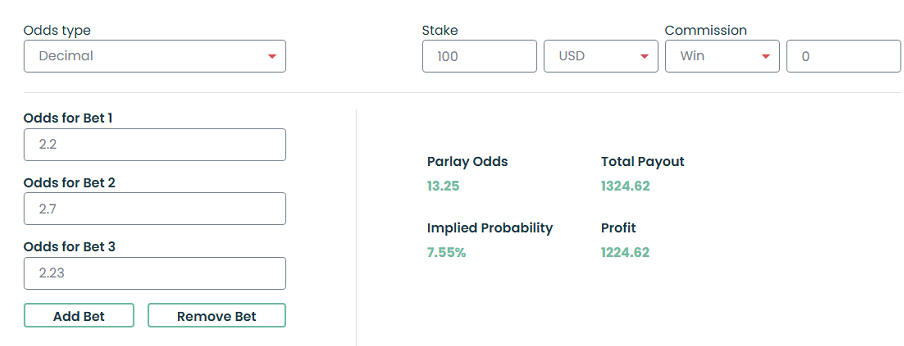
It’s something like parlay bets, which is the combination of several bets at once. By the way, it’s quite easy to calculate such bets now with the help of a handy parlay betting calculator that usually have many betting tools.
Classification by event timing:
Surebets are also divided into Prematch and Live opportunities. Prematch arbs are available before an event starts, whereas Live arbs appear after play has begun and the odds are changing in real time.
Each format has advantages and drawbacks. Live markets may offer higher margins and more frequent opportunities, and this activity can sometimes attract less immediate attention from bookmakers.
The main difficulty is speed. Live odds can change within seconds, so an inexperienced bettor may complete one side but fail to place the other at the expected price.
Prematch arbs generally provide more time for checking the market and placing every selection, which makes them a more comfortable starting point. Their drawback is stronger competition and a potentially greater risk of stake restrictions.
A simple surebet calculation
The following tennis example shows how the method works in practice.
Suppose a WTA match between Timea Bacsinszky and Madison Brengle is priced differently by two operators. Bookmaker 1 offers odds of 2.10 on H1 (-5.5), while Bookmaker 2 offers 1.961 on H2 (+5.5).
With a total bankroll of $100, the stakes can be distributed according to the implied probabilities. Approximately $48.30 is placed on H1 (-5.5), and $51.70 is placed on H2 (+5.5) at odds of 1.961. The calculator then produces the following balanced position:
If both wagers are accepted and settled normally, either outcome produces a return of roughly $1.40 above the original $100 stake.
How bettors locate surebets
After understanding the calculation, the practical issue is finding suitable opportunities before the prices disappear. Bettors can compare bookmakers manually or use a dedicated sure bet finder such as BetBurger.
Manual searching is more demanding than it initially appears. It requires monitoring many operators, matching equivalent markets, checking settlement rules, and calculating the correct stake distribution quickly and accurately.
Arbitrage scanners automate much of this work. For a subscription fee, they compare bookmaker lines continuously and display qualifying combinations, allowing the bettor to focus on verification and execution instead of repetitive searching.

Conclusion
Surebetting is based on mathematics rather than a prediction about the winner, but it is not entirely risk-free. Odds can move, stakes may be limited, and incorrect lines may be cancelled. Understanding the manual calculation remains useful even when a scanner is used, because every opportunity should still be checked before money is committed.